Showing posts with label history. Show all posts

Monday, July 27, 2015

Holy Moly, A Publication

After a lot of hard work, I'm so happy to announce that my first "real" published article is out!  In spring 2014, one of my professors encouraged me to write a paper critically analyzing four graphic history books about the Battle of the Alamo, and it's one of the most fulfilling, interesting academic journeys I've ever taken.

While writing this paper, I was able to travel back to my childhood and relive wonderful memories of visiting San Antonio and learning about my home state's history.  However, I also had to confront the fact that the "official" (i.e., popular and dominant) story of the Alamo is pretty biased, inaccurate, and sometimes flat-out racist.

dramatic picture via The Young Turks

After the paper was finished, my friend and co-author, Margaret Robbins, provided some helpful input (many thanks, Margaret!), and we sent it off to Social Studies Research & Practice.  If you'd like to read the article, you can find it here.  It's an open-access online journal, so you'll be able to read the whole thing and/or download it for free.

I hope you enjoy it!

Tuesday, July 21, 2015

Challenging Racism with Graphic Novels

Now, more than ever, we need to talk about racism.

 via Race Report 

Yes, Confederate flags are coming down.  They needed to come down years and years and years ago.  But now that the flags are gone from government buildings in South Carolina, The Dukes of Hazzard has been pulled from the airwaves, and musicians are removing Confederate symbols from their shows, I bet there are more than a few people out there who are thinking, "Good job, problem solved, don't need to think about this anymore."  Once all of this "dies down" (i.e., major media networks stop covering the flag, police violence, etc.), many will be happy to forget about racism or think that our problems are solved.  Meanwhile, there are those who insist on minimizing racism, explaining it away, or flat-out denying that it exists.

Racism is still out there, pervading every aspect of our society.  Getting rid of Confederate symbols in public spaces is a step in the right direction, but one potential downside to banning them everywhere is that we might inadvertently silence dialog about why Confederate symbols are oppressive in the first place and potentially foster a belief that getting rid of hateful symbols erases racism.  No, racism is an institution, grounded in history, that goes far beyond symbols.  As educators, parents, and friends, we need to talk about it with young people and among ourselves.

via WUSF

That's where books come in.

A helpful way to understand racism and its current persistence in our society is to read histories that trace the journeys of ethnic groups through our nation's past and into the present.  Engaging with these books can show readers how, for example, slavery might be over, but the effects of slavery are still very much with us today in the forms of White privilege and systemic discrimination against Black people.  As Crowley & Smith (2015) pointed out, people need to understand racism through a "knowledge of history and an appreciation for structural inequity along racial lines" (p. 172).

The books that I'm about to recommend can be useful in high school classrooms or for adults who are interested in exploring the history of racism and discrimination in the US more thoroughly.  I believe doing so is extremely important because these issues are often glossed over or completely omitted from traditional histories and other reading materials that many of us encountered in school and that students are still reading today.  Also, I chose graphic novels because they're accessible, visual, and incredibly engaging to read -- a great break from textbooks.

First is Still I Rise: A Graphic History of African Americans (Laird & Laird, 1997/2009), an overview of Black history that I just finished.


I love this book because it provides tons of information left out of history textbooks, such as a closer look at the beginnings of slavery, Reconstruction, and the beginnings of the Civil Rights movement.  Still I Rise presents readers with a fantastic amount of balance, exploring the bad (violence, discrimination) with the good (the important contributions of Black inventors, politicians, artists, etc., to our society) and showing the diversity of Black opinions, experiences, individuals, and communities in our country.  Most important to me, however, is that this book shows how racism has persisted over the years and that despite progress, we must continue to fight against it.

Of course, racism isn't just a Black and White issue.  Fortunately, there are other fantastic graphic novels that demonstrate the roots of racism and can foster ruminations and discussions about race/ethnicity in history and today.

Latino USA (Stavans, 2000/2012) is an excellent option:


This book traces the history and diversity of Latin@ people in the US and shows readers the roots of racism and how it continues today.  Like Still I Rise, Latino USA presents multiple perspectives within and among Latin@ communities about historical and contemporary issues, demonstrating how Latin@s aren't a homogeneous group and encouraging critical thinking.

Granted, simply reading a book won't convince everyone of our dire need for racial justice and healing in the US -- but an engaging piece of literature can be a wonderful springboard.  Coupled with deep discussion, reading can be a transformative act.  So share books like these with your high school students, your children, your adult friends.  Read and discuss.

Do you know of any other good books that explore history and racism and want to recommend them?  Let me know!

Sunday, May 3, 2015

Review: Angela Johnson's All Different Now

Title: All Different Now: Juneteenth, the First Day of Freedom
Author: Angela Johnson
Illustrator: E.B. Lewis
Publisher: Simon & Schuster
Age Range: 8+


Attempting to learn about history from a textbook can be a dull, even futile effort.  As social studies education scholar Bruce VanSledright points out in his book The Challenge of Rethinking History: On Practices, Theories, and Policy (2011), textbooks present students with a number of obstacles that can hinder their acquisition of historical knowledge.  First, textbooks often gloss over historical happenings, "condensing rich, complex events into [...] compressed accounts" (p. 39) -- rushed, shallow, paragraph-long blurbs that can't possibly help readers build deep, nuanced interpretations about the past.  Instead, kids need to read various accounts (primary and secondary sources) that present different perspectives about historical events.  When they do so, they learn that history isn't quite as simple as a textbook might present it, and they begin to be able to handle constructively the dissonance that varying points of view can create -- a skill they'll need in the real world, a place full of diversity and sundry ways of being and thinking (Barton & Levstik, 2004).

Another problem with textbooks is that they often present history as a "fait accompli" (VanSledright, 2011, p. 79), a done deal or an open-and-shut account of events that can leave readers bored and wondering whether the past has any relevance in our present lives.  "Why should we care about what happened back then?" they might ask.  "Let's just memorize this boring story and get it over with."  But history has so much more to offer, and utilizing resources like All Different Now -- Angela Johnson's moving poem about a young girl learning on June 19, 1865 that she's free -- invites teachers and students to move beyond the textbook and reclaim the fascinating work of doing history.

What I really love about this book is how it brings the past to life and presents the first Juneteenth as a dynamic, open-ended occasion.  E. B. Lewis' illustrations -- watercolor representations of photographs -- look incredibly realistic, showing readers what people might really have looked like as they experienced their freedom for the first time.  Whereas textbooks often rely on flat, black-and-white photographs to represent the nineteenth century, these images are colorful and alive.  Children can clearly see that slaves were real people who had families, "worked [...] under the hot Texas sun" (Johnson, 2014, n.p.), and felt real joy when they learned about emancipation.


Moreover, Johnson's words and Lewis' illustrations convey to readers that the first Juneteenth and the following years were a complex period in history by implying that, after emancipation, things were "all different now," not "all better now."  Yes, readers will see the people in the book experiencing relief and happiness as they "ate as free people / laughed as free people / and told stories as free people" (Johnson, 2014, n.p.), but they will also see the uncertainty that many people felt as they moved forward into their new lives.  In the last two pages of the book, we read the words "all different now" and see the narrator's family leaving their slave quarters.  Their faces display a variety of emotions -- hope, concern, ambiguity.  While emancipation released Black Americans from the bonds of slavery, it wasn't the end of trouble, and many (if not most) former slaves faced continuing racism and violence.  I like how All Different Now acknowledges this reality and leaves the ending open.  The story isn't over; it's not an open-and-shut chapter in history; it's not a "fait accompli."


Introducing this book in the classroom and constructing lessons around it can provide students with learning opportunities to foster not only their historical thinking skills but also other academic abilities.  Reading All Different Now and other primary and secondary sources about Juneteenth (in addition to or in place of textbook reading) can allow students to compare multiple perspectives about the event, encouraging them to develop a more nuanced understanding about emancipation.  Also, teachers can help students connect past and present by investigating how Juneteenth is celebrated today.  For example, if some students observe this holiday themselves, they can invite family members and friends to teach their classmates more about contemporary celebrations.  Furthermore, engaging with this book can strengthen children's literacy skills (Duke, Bennett-Armistead, & Roberts, 2003).  Encountering new words can build vocabulary (Dreher, 2003), while teachers can encourage students to develop their writing skills by creating their own poetry about a historical event (Ray, 2004).

Juneteenth celebration in Austin, 1900

With all of the great nonfiction and historical fiction children's literature out there, teachers don't have to worry about relying on textbooks.  By welcoming books like All Different Now into the classroom, we can give our students all kinds of wonderful opportunities to connect with the past.

Helpful Resources
  • An article by Henry Louis Gates, Jr., containing several quotations (primary sources) from former slaves about Juneteenth and emancipation
  • Some examples of how Galveston, Texas (where emancipation was announced) celebrates Juneteenth today  

References

Barton, K. C., & Levstik, L. S. (2004). Teaching history for the common good. Mahwah, NJ: Erlbaum.

Dreher, M. J. (2003). Motivating struggling readers by tapping the potential of information books. Reading & Writing Quarterly, 19, 25-38.

Duke, N., Bennett-Armistead, V. S., & Roberts, E. M. (2003). Filling the great void: Why we should bring nonfiction into the early-grade classroom. American Educator, 27(1), 30.

Johnson, A. (2014). All different now: Juneteenth, the first day of freedom. New York, NY: Simon & Schuster. 

Ray, K. W. (2004). Why Cauley writes well: A close look at what a difference good teaching can make. Language Arts, 82, 100-109.

VanSledright, B. (2011). The challenge of rethinking history education: On practices, theories, and policy. New York, NY: Routledge.

Monday, February 23, 2015

Review: Nina Shor's Arte Popular

Title: Arte popular: Búscalo y encuéntralo (Folk Art: Look and Find)
Author: Nina Shor (Mexico)
Illustrator: Various artists (Mexico)
Publisher: Ediciones El Naranjo
Ages: 6+


The children's literature library in my university's education building has a great, growing collection of Spanish and dual language books, and I first noticed this title on the New Arrivals shelf a few months ago.  I love me some traditional arts and crafts and was curious to see what was inside, but I didn't have any time to stop and look at the book, so I left and forgot about it.

Until I saw the same book in that magical bookstore in Puebla and snatched it right up.

Arte popular is a treasure trove of Mexican folk art.  Each section of the book contains a different type of art from a particular region.  Large, detailed photographs, interviews with artists and craftspeople, and information about each art form's history and functions show readers how diverse and useful art can be.  For example, readers will learn that art can:

Be clothing (like huipiles in Oaxaca)

Depict religious beliefs and understandings 
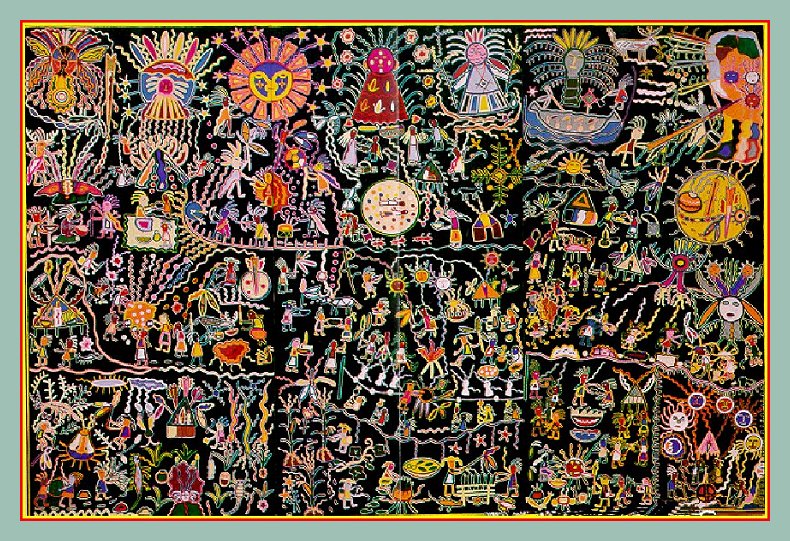
(like Huichol tapestries in Nayarit, Jalisco, Durango, and Zacatecas)

Help people observe special occasions (like papel picado in Puebla)

Before introducing each art form, Nina Shor encourages readers to examine each work closely by providing them with a list of details to search for as well as questions to consider.  This challenge makes the book more interactive and asks children to think more deeply about what they're seeing.

Since the text is in Spanish and intended for more advanced readers, younger and/or monolingual English-speaking kids might need adult assistance when gleaning information from this book.  Children can certainly enjoy the artwork on their own, but their experiences with this book will be so much richer if they can access the text and learn about the meanings behind the photographs.  Therefore, I would recommend Arte popular to Spanish, dual language, Mexican American Studies, and Spanish-speaking art teachers.  Or, if you don't speak Spanish but know someone who wants to help you translate, go for it!  This book is too good to pass up.
Tuesday, November 25, 2014

Dismantling the Thanksgiving Myth: Helpful Links

As I've mentioned before, I was terrified of angering parents when I was a classroom teacher.  Because of this fear, I shied away talking about anything controversial with my students -- including Thanksgiving.  I've known for a long time the mythical nature of the United States' beloved Thanksgiving story, but since I didn't want to be accused of "playing the race card" or "harming children's innocence," I avoided the Pilgrim-and-Indian story altogether.

None o' this.

Instead, I focused on the basic practice of being thankful.  There are some great books out there that focus on gratitude without dragging in the Thanksgiving myth -- my personal favorite is Pat Mora's Gracias/Thanks, a wonderful reminder to be thankful for the little things in life.  Also, my students and I made "We Are Thankful for..." books.  It was a great time.

However, while there's nothing wrong with emphasizing gratitude (which, after all, should be the focus of such a holiday), I see now that simply ignoring the Thanksgiving myth won't make it go away.  Even if we educators don't actively perpetuate the story at school, kids will pick it up somewhere else from popular media that often portrays an incorrect, racist version of the Pilgrims' arrival in Plymouth.


So in addition to celebrating gratitude, it's important to dismantle the legend so that kids don't internalize false, harmful information about Thanksgiving.  I know it's a little late to talk about the holiday in schools, but it's never too early for teachers to start planning discussions and activities for next year, and parents still have time to address these issues with their children at home.

And if, like me, you're at a loss for strategies to begin critical discussions of the Thanksgiving myth, check out these links:


I hope you have a warm and safe holiday, and, as always, let me know your thoughts on critical literacy topics like this one!

Monday, November 3, 2014

Review: Alma Flor Ada & Isabel Campoy's Yes! We Are Latinos

Title: Yes! We Are Latinos
Authors: Alma Flor Ada (Cuba, US) & Isabel Campoy (Spain, US)
Illustrator: David Diaz (US)
Publisher: Charlesbridge
Age range: 9+


I've been wanting to review this book ever since it came out last year, and I'm so excited to finally share it with you!  Yes! We Are Latinos is a stunning collection of poetry created by two prolific writers and scholars, Alma Flor Ada and Isabel Campoy.  Whether working separately or as a team, Ada and Campoy always produce thoughtful, charming works of children's literature -- and with this book, they've outdone themselves.

The purpose of Yes! We Are Latinos is to share and explain the diversity of Latin@ people living in the United States.  Rather than being a homogenous group, Latin@s have different ethnic backgrounds, live in different parts of the country, and speak different languages.  Therefore, each clear, uncluttered poem represents a fictional individual who shares information about his/her background and life with readers.

For example, Susana -- who has Sephardic Jewish heritage -- loves listening to her grandmother sing old, traditional songs and is trilingual -- fluent in English, Spanish, and Ladino (also known as Judeo-Spanish).

Felipe -- who identifies as Panamanian, Venezuelan, and Black -- wants to protect his cousin Angelita, who has Down Syndrome, from verbally abusive bullies.  But he wants to be her "champion" through painting, not fighting (p. 60).

Best friends Lili and Michiko -- who are Guatemalan-Chinese-American and Peruvian-Japanese-American, respectively --  are excited to learn more about their immigrant grandparents' home countries and languages.  However, they're also tired of telling people that they can, in fact, be simultaneously Asian-American and Latina.

Supplementing these poems are informative prose explanations of various historical events (slavery, the expulsion of Spain's Jewish population in the Middle Ages, the Spanish Civil War) and ongoing practices (immigration, the struggle for indigenous rights in the Americas) that clearly explain how the past and present have shaped the various ways to be Latin@.  Meanwhile, David Diaz' intricate black-and-white cut-out illustrations emphasize the poems without distracting readers from the text.

By exploring their characters' roots, struggles, and hopes, Ada and Campoy show readers the nuances of being Latin@ and successfully stress how Latin@ people lead very different lives and construct their identities in their own ways.


Because of Yes! We Are Latinos' true and loving celebration of diversity, teachers can easily incorporate it into an anti-bias curriculum.  After reading the poems together, teachers can also encourage students to write their own identity poems in which they describe their cultural backgrounds, family histories, personal interests, and the intersections of these complex facets of their lives.  

The poems are also wonderful resources for language learning.  Since Ada and Campoy weave Spanish seamlessly into their English-language verse, students of all language backgrounds can learn about the complexity of code-switching.  Moreover, the new Spanish translation of this book can be a great text for bilingual and Spanish as a Heritage/Foreign Language classrooms.

So go check out Yes! We Are Latinos!  But you don't have to take my word for it.

Saturday, October 11, 2014

Another Columbus Day Post

I am The Best Artist.

For a different type of Columbus Day critical literacy activity, take a couple of minutes to look through this infographic from Matthew Inman, creator of The Oatmeal.

Done?  OK.

I love infographics, or visual -- almost comic-like -- representations of data or information.  They're fun, easy to process, and a nice break from reading big chunks of text.  Because of their visual nature, they can be very appealing to kids.  Therefore, analyzing infographics can be an interesting, motivating way for students to engage in critical literacy.

Since Columbus Day is upon us, reading and critiquing Matthew Inman's infographic about Christopher Columbus could be a great activity for middle and/or high school students during the coming week.  Teachers and students can tease apart Inman's argument against celebrating Columbus day and discuss how they agree or disagree with his points.

For example, I definitely agree with his argument that Christopher Columbus is not a person worthy of celebration -- he brought a wave of terror to the Americas that still lingers today, and I refuse to honor him and his legacy.


However, I'm not in agreement with Inman's idea to switch the second Monday in October to "Bartolomé Day."  Yes, we should pay more attention to Bartolomé de las Casas and his deeds in history classes, but why should we shift our focus from one European to another?  

Why not focus on indigenous Americans and their history, current events, accomplishments, and diversity -- not just in October but year-round?  (Inman does reference Seattle's Indigenous People's Day, which is not without its own critics, in an update at the bottom of the page.  But it's an afterthought.)

Teachers, how invigorating it would be for students to explore different perspectives on Columbus Day and share their opinions about the holiday and Inman's piece?  Then they might create their own infographics (digital literacy woooo!) to share with each other, their school, and the internet community.

The kids I work with aren't quite old enough to read The Oatmeal, but I'm looking forward to having a nice dialog about Columbus Day with them this week.  But if you have attempted / want to attempt an infographic critical literacy activity like this with your kids, let me know about it!

Tuesday, August 26, 2014

KidLit in Puerto Rico: Part Two

Picking up where I left off last time.

So I went to Puerto Rico and found quite a few interesting children's books.  In my last post, I discussed anti-bias/anti-racism textbooks and collections of poetry, so now I'm going to bring it on home by exploring some of the nonfiction(ish) literature I came across.

The first book is Everywhere Coquís / En Dondequiera Coquíes (Hooper, 2007), which can be found in many, many Puerto Rican gift shops and caught my eye because of its appealing construction -- you can read the book in Spanish and then turn it over and flip it upside down to read it in English.


I've categorized this book as nonfiction, but that's only partially true, since the overall plot of the book is fictional, while many of the details present factual cultural information about Puerto Rico.  In this story, a group of coquís -- tiny but vocal frogs that are widely beloved in PR -- are chased out of the rainforest by parrots and wander through the countryside and into the city, where they encounter several well-known sights, like a piraguas (snowcone) vendor, artists who craft vejigantes (traditional masks) and santos, and musicians playing traditional music.


La Mano Poderosa (All Powerful Hand)
and Los Reyes Magos (Three Kings)

Honestly, this book disappointed me for a couple of reasons.  First, I thought it would be a purely nonfiction, scientific presentation of coquís: their history, anatomy, habitat, etc.  Second, I'm concerned about the "tourist" nature of the text.  While the aspects of Puerto Rican culture depicted in the book -- food, art, music -- are definitely important and worth learning about, they don't cover the many and complex ways of being Puerto Rican.  Therefore, this book can be a sweet, charming way to introduce children to the island and some of its cultural practices, but reading other books is necessary to prevent kids from possibly developing a narrow, stereotyped view of Puerto Rico.

Next I have to discuss the vast amount of information on the Taínos (the indigenous people living in Puerto Rico when the Spanish arrived) that I encountered during my trip -- nearly every museum and gift shop sold Taíno artifact replicas and books.  Since many of us living in the US aren't familiar with Taíno history, here's a very brief overview (source):

  • The Taíno people lived in Puerto Rico, Cuba, Hispaniola, Jamaica, and many other areas of the Caribbean.  Their ancestors probably first arrived in this areas around 400 B.C.
  • They first encountered Europeans (led by Columbus) in 1492.
  • By the 1530s, most Taíno people had died due to warfare, disease, and slavery brought by the Europeans.  Also, many indigenous women married Spanish men.
  • Although (probably) no one in the Caribbean has 100% indigenous ancestry, there are many people who identify as Taíno and keep Taíno cultural practices alive.
...Which brings me to two children's books dealing with indigenous topics.  First up is Tai: El Pequeño Tayno / Tai: The Little Taíno (Otero, 1972/2007), the first in a series of historical fiction texts about a little boy going about his business in pre-conquest Puerto Rico.


In this story, Tai eats breakfast, takes a bath, helps his family with chores, watches artisans creating ceramic wares, says hello to the local leader, and helps fisherman unload their fresh catch from their canoes.  Clearly, this book's creators want to teach children about various aspects of Taíno life in the past, including daily work, recreation, clothing, vocabulary, etc.  Everything about this book seems aboveboard -- the language is respectful, and the illustrations look accurate.  However, I'm definitely no expert in Taíno culture, so I'd be interested to hear what a more knowledgeable reader might have to say about this text.


Overall, reading this book left me with several questions about how the Taínos are perceived in Puerto Rico today.  How many people identify as Taíno?  How are these people viewed and treated by the government and other Puerto Rican residents?  What and how do children learn about Taínos and the Spanish invasion in school?  Lots of interesting topics to investigate.

Finally, I present to you De Cómo Nació El Amor / How Love Was Born (Álvarez Astacio, 2010), a book that I want to love but just can't.


It's another book that tries to pay homage to indigenous peoples, but, sadly, it just doesn't work.  Here's an excerpt from the introduction:

"This book is a myth about the origin of love; that very love for life that we feel in the depths of our heart.  The mythical space, created by the illustrations in this book, is based on the picturesque depictions from various indigenous groups around the world; those that once existed and those that are still in existence today."

Two sets of questions: First, where did this myth come from?  Is it a story that comes from a specific group of people, or is it yet another made-up story that seems nice because it "sounds Indian"?  If this tale does come from a specific group of people, why are those people not named in this book?

Second, why take a bunch of different indigenous art styles and mash them together?  Is the illustrator homogenizing indigenous cultures, implying that they're all more or less the same?  Because of these problematic elements, it would be best to use this book to teach kids critical reading skills but not to teach them about indigenous peoples.

To wrap up, I'd like to recommend exploring local children's literature offerings when you go on trips, either here in the US or abroad.  Doing so can really enrich your experience by teaching you more about your surroundings or by giving you something to ponder as you travel.  I hope you're having a great week, and I'll see you next time!

Sunday, August 17, 2014

KidLit in Puerto Rico: Part One

Well, I’m back from my trip to Puerto Rico, and I’m so grateful for the opportunity to visit such a culturally rich and beautiful place.  After spending some time in Vieques, I was able to travel to El Yunque Forest – the only tropical rain forest in the US National Forest System – and Old San Juan.

El Yunque was breathtaking and unlike anything I’d ever seen before…

View from the Mt. Britton tower 

Los Picachos 

World's cutest tiny waterfall

But I’m a sucker for cities and LOVED San Juan.  Wandering through the Museo de las Américas, peering into the grand old churches, and sipping coffee were especially enjoyable.  (The coconut latte at Don Ruiz = very yes.)

Calle San José 

El Morro fortress 

Catedral San Juan Bautista 

La Virgen de Monserrate @ El Museo de las Américas

And because I’m me, of course I kept my eyes open for children’s literature and other types of multicultural educational texts along the way.  I was extremely curious about what I’d find, since I’m familiar with plenty of Puerto-Rican-American kidlit (such as works by Judith Ortiz Cofer, Carmen Bernier-Grand, Esmeralda Santiago, and Lulu Delacre), but, aside from the civic action comics I found in Vieques, I’ve never encountered any children’s books from Puerto Rico.

Fortunately, I wasn’t disappointed.  While the books I found certainly aren’t representative of all Puerto Rican children’s literature, I stumbled upon some very interesting titles in museum shops and independent bookstores. 

First up are two textbooks that I encountered in several stores.  Arrancando Mitos de Raíz (Uprooting Myths of Race) is an instructional text for teachers that focuses on dispelling racial myths and stereotypes about Puerto Rican people of African descent. 


Alongside this work was a textbook for students about Puerto Rico's African heritage called La Herencia Africana.


I loved seeing these books, since evidence of African cultural practices is very strong on the island, and so many Puerto Rican people have African ancestry.  Also, sadly, people of color face a lot of discrimination in PR, just as they do in the rest of the United States and other parts of the world.  However, I'm left wondering how popular these textbooks are in Puerto Rican schools and teacher preparation programs.  How widespread are anti-racist educational programs on the island?

Next, we have some poetry.  La Rosa Va Caminando (The Rose Goes Walking) is a collection of poems written by a young girl, Elsa Tió, between the ages of five and nine.  Still an active writer today, Elsa was a literary prodigy who crafted poems about subjects like nature, family, and love, and Sofía Sáez Matos has sumptuously illustrated Tió's verses with painted collages reminiscent of Eric Carle's work.


At Librería La Tertulia, a small store packed with some wonderful books in both Spanish and English, I came across another compilation of poetry for children -- Poemas con Sol y Son (Poems with Sun and Sound).  


This volume features poems from all over Latin America, and Puerto Rico is represented by six poets.  My personal favorite is by José Antonio Dávila:

La luna más que redonda
hoy está llena.
Tiene la cara hinchada
como el que tiene
dolor de muelas.

(The moon is more than round -- 
tonight it's full.
It has a swollen face
like someone who has
a toothache.)

:D

Well, I think I'm going to make this post a two-parter, so STAY TUNED for more Puerto Rican children's literature -- next time, I'll focus on non-fiction.  I hope everyone is having a wonderful start to the new school year!  (And if you're not a teacher, parent, or student... Happy Mid-August!)