Showing posts with label Mexico. Show all posts

Tuesday, May 12, 2015

Manuel Monroy: Illustrator of the Week

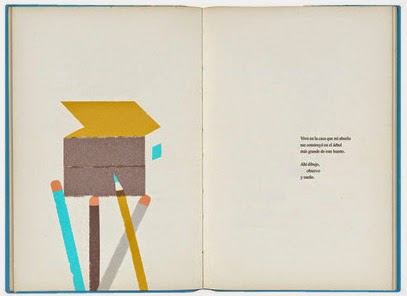
This week's illustrator is Manuel Monroy!  Mr. Monroy received his degree in graphic design from la Universidad Autónoma Metrpolitana in Mexico City and has created art for children's books, magazines, advertisements, and animations for the past twenty years.  During that time, he's also won multiple awards and has shown his work in exhibits around the world.  Here's a sampling of his artwork from his website:


His images are all about balance -- they're soft yet expressive and combine earth tones with pops of bright color.  Also, they're just so dang cute, soothing, daydream-y, and perfect for picture books.  If you'd like to add some of his illustrations to your home or classroom library, hit the links below:

What Are You Doing? (Elisa Amado, also available in Spanish)

Why Are You Doing That? (Elisa Amado, also available in Spanish)

Be a Baby (Sarah Withrow, also available in Spanish)

Rooster/Gallo (Jorge Lujan)

Daybreak, Nightfall (Jorge Lujan, also available in Spanish)

When I Was a Boy, Neruda Called Me Policarpo (Poli Delano, also available in Spanish)

Un pueblo lleno de bestias (Francisco Hinojosa)

¿Quién pasó por aquí? (Martha Duhne)

Happy reading!

Tuesday, April 21, 2015

KidLit in Chicago

I've been yearning to go to Chicago for years now, and I finally got my chance last week when I attended the American Educational Research Association (AERA) annual meeting.  The city did not disappoint!  (I didn't want to leave.  Can I go back now?)  When I wasn't doing conference stuff, I had several opportunities to get out and explore.  Here are some highlights:


Colonial-era painting of La Virgen de Cayma (Perú) @ the Art Institute of Chicago


This looks better than any of the pictures I took.

My favoritefavoritefavorite excursion, however, was visiting the Pilsen neighborhood and the National Museum of Mexican Art on the Lower West Side.  In addition to a beautiful permanent collection -- with everything from Mesoamerican sculpture to contemporary video art -- they have a few temporary exhibits, like the brand new collection inspired by Sandra Cisneros and her landmark novel, The House on Mango Street, which is set in Chicago.


I wish I could've taken pictures of the artwork because the collection included paintings by two of my favorite artists / children's book illustrators: Carmen Lomas Garza and Rafael López.  (Photography isn't allowed in temporary exhibitions at most museums, though.  Oh well.)  Fortunately, there was another Garza painting in the permanent collection, so I snapped a picture of that one:

Las posadas (2000)

Even better, the gift shop had a great selection of Latin@ and Latin American children's books, many of which I'd never seen or heard of before.  One book that really caught my attention was El gusto del mercado mexicano / A Taste of the Mexican Market by Nancy María Grande Tabor.


In this dual language book, Tabor -- who's from Loreto, Mexico -- guides readers through a traditional market, showing them popular Mexican foods and asking questions that reinforce math and science skills (e.g., "If we choose two of each [pastry], how many will we have?" and "Which of these ripe fruits are still green?").  I love this book, not only because of what it teaches, but also because of how Tabor presents the information.  Instead of presenting this Mexican cultural practice as exotic and strange to US readers (as many books about international cultures do, unfortunately), she depicts visiting a market as an interesting (but ordinary) practice that some people do.  Good stuff.

Another great book was Lotería by Patty Rodriguez, a dual language board book by a publisher called Lil' Libros.


Each page spread features a super-cute representation of a lotería card with Spanish and English captions.  Since there are lots of bilingual babies in my life, I bought a copy and was able to test it out on my friends' seven-month-old little dude as soon as I got back to Georgia on Saturday.  He focused intently on each page, laughed when I made Spanish and English rooster noises, waved his chubby little arms, and then shoved the book in his mouth when we finished reading.  So... SUCCESS.

Chicago is a beautiful stronghold of Latin@ (especially Mexican-American) culture, so if you get a chance to visit and are in the market for some great Latin@ children's literature and cultural experiences, they can hook you up.  I miss it already.

And now I leave you with the song that's been stuck in my head for a week:

Monday, February 23, 2015

Review: Nina Shor's Arte Popular

Title: Arte popular: Búscalo y encuéntralo (Folk Art: Look and Find)
Author: Nina Shor (Mexico)
Illustrator: Various artists (Mexico)
Publisher: Ediciones El Naranjo
Ages: 6+


The children's literature library in my university's education building has a great, growing collection of Spanish and dual language books, and I first noticed this title on the New Arrivals shelf a few months ago.  I love me some traditional arts and crafts and was curious to see what was inside, but I didn't have any time to stop and look at the book, so I left and forgot about it.

Until I saw the same book in that magical bookstore in Puebla and snatched it right up.

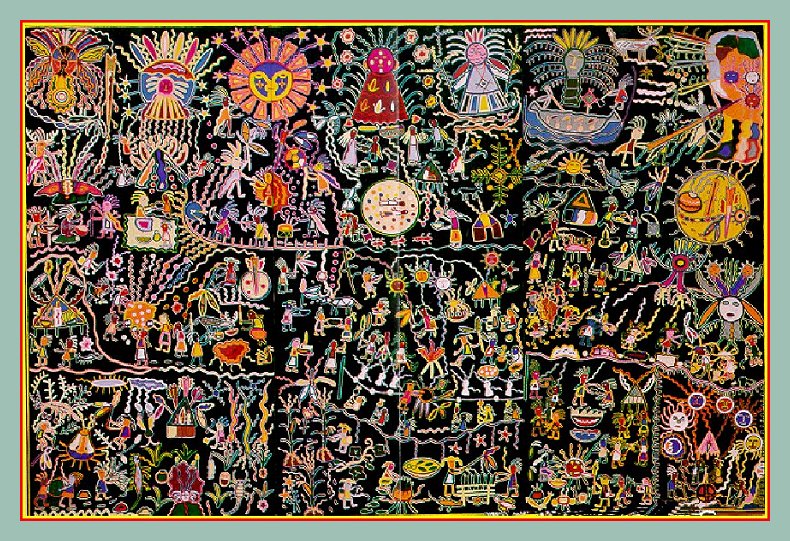
Arte popular is a treasure trove of Mexican folk art.  Each section of the book contains a different type of art from a particular region.  Large, detailed photographs, interviews with artists and craftspeople, and information about each art form's history and functions show readers how diverse and useful art can be.  For example, readers will learn that art can:

Be clothing (like huipiles in Oaxaca)

Depict religious beliefs and understandings 
(like Huichol tapestries in Nayarit, Jalisco, Durango, and Zacatecas)

Help people observe special occasions (like papel picado in Puebla)

Before introducing each art form, Nina Shor encourages readers to examine each work closely by providing them with a list of details to search for as well as questions to consider.  This challenge makes the book more interactive and asks children to think more deeply about what they're seeing.

Since the text is in Spanish and intended for more advanced readers, younger and/or monolingual English-speaking kids might need adult assistance when gleaning information from this book.  Children can certainly enjoy the artwork on their own, but their experiences with this book will be so much richer if they can access the text and learn about the meanings behind the photographs.  Therefore, I would recommend Arte popular to Spanish, dual language, Mexican American Studies, and Spanish-speaking art teachers.  Or, if you don't speak Spanish but know someone who wants to help you translate, go for it!  This book is too good to pass up.

Tuesday, February 10, 2015

Review: Ka'ya ta kutu'a kun Ñuu Savi

Title: Ka'ya ta kutu'a kun Ñuu Savi / Adivinanzas en mixteco, la lengua de la lluvia / Mixtec Riddles
Compiled by: Alejandra Cruz Ortiz
Illustrator: Octavio Moctezuma Vega
Publisher: Artes de México
Age Range: 4+

You might have noticed that bilingual books are (thankfully) somewhat easier to find these days, but have you ever seen a quintilingual book?  Well, guess what I found in Mexico.

Oh yes.

This colorful book of riddles offers readers brainteasers in five languages -- three varieties of Mixtec, Castilian Spanish, Catalan, and English.  For those of you who, like me, aren't super familiar with Mixtec, here's brief introduction from mixtec.org:
"Mixtec belongs to the Otomanguean group of Mesoamerican languages.  Proto-Otomanguean, the mother language, was spoken by hunters and gatherers in the region over 10,000 years ago.  A forerunner of contemporary Mixtec appeared some 7,000 years ago.
"It is misleading to talk about Mixtec language as a single, uniform system of oral and written communication.  By some estimates, there are thirty or even fifty variations of the language, some of which are very different from one another.  Residents of settlements separated by a few miles may only understand about 10-25% of what each other says [....]
"In the 500+ years since the arrival of Cortés, Mixtec has adopted or adapted Spanish words for which there are no Mixtec equivalents.  And today, because of the heavy migration between Oaxaca and the United States, Anglicisms are increasingly creeping into the language.  A startling, but no longer uncommon scenario in schools in the Mixteca [region were Mixtec is commonly spoken] is the following: A Spanish-only speaking teacher, educated in Mexico City, leads a classroom comprised of Mixtec-only speaking students, bilingual Mixtec-Spanish speakers, and bilingual Mixtec-English speakers."

Areas of Mexico where Mixtec languages are spoken

This passage illustrates how rich and complex languages are in Mexico.  With so many linguistic traditions coming together and mingling, it seems wise to create books like this one that recognize and utilize several of them together.  Also, I love how the book honors the Mixtec varieties -- which, sadly, some people view as useless or inferior -- by placing them first on the page instead of below Spanish or English, two more dominant, privileged languages.

Would you like a preview?  Here's a riddle:

Pinotepa, Oaxaca
Yu'u chavixi kuui vati chike nuu ndi'i ita
Chakan ñi ña'an kuniñi ko'oñi ñuñuyu
Ri saa ndio'o.

Xalpatláhuac, Guerrero
Visi ni vaku il chi
Xika ni'i nuu ita
Soo ndi'i na si'i ndiki na ko'o na ñuñu ii
Miñaa nada yo ku ii kuka'ndo.

Huajuapan, Oaxaca
Yu'u kuu iin ña v idji chii xikanuui tanuu,
tanuú ita ta ndi'i ña'a kutondodjo ñuñui kunina.

Castellano
¿Ya sabes quién soy?
Chiquito de mil colores,
por el lugar de las nubes voy.
Del dulce de mil flores
me deleito con sus sabores.

Català
Petit ocell multicolor
Vaig per les flors tastant sabors.
No pots endevinar qui sóc?

English
Even though I'm small in size,
I have many colors to delight the eyes.
I like to spend hours and hours
Drinking sweetness from the flowers.

And the answer is...

Yoo kuu yu'u: Saa ndio'o
Saa ndio va ku ii
Ndiyoo kuui. Ndiyo'o
El colibrí
El colibrí
Hummingbird

Love it.  And just think of all the possibilities for using this book in your classroom or at home with your children.  You might discuss translation and issues of linguistic diversity and marginalization with older kids, or you might provide younger students with opportunities to write their own riddles in any language they want.

As for me, I'll be giving Ka'ya ta kutu'a kun Ñuu Savi to my friends who are raising their son to speak Catalan, Spanish, and English, because seriously -- how many North American-published books can you think of that include Catalan (another marginalized, persecuted language)?  If you'd like to snatch up a copy for yourself, you can order it directly from the publisher or buy it used through Amazon or Barnes & Noble.  Enjoy!

Monday, January 19, 2015

KidLit in Puebla

Hey everyone!  Well, I took a nice, long break from blogging, so I'm rested and ready to get back to all things children's literature.  I hope y'all enjoyed your holidays and are having a great start to the new year!

Earlier this month, I had the opportunity to travel to Puebla, Mexico, and... wow.  Seriously, if you're into traveling, put it on your list right now -- it's a beautiful, friendly place with way too much to do.  Here are some highlights:

Approximately one billion churches

Colonial buildings covered with Talavera tile

Mesoamerican ruins (and more churches) in nearby Cholula

A sweet old library

Slightly terrifying volcanoes

And bookstores!  Bookstores everywhere, from tiny spaces and stalls selling used novels to big, shiny stores filled with textbooks.  My favorite, however, was a non-profit organization called Profética: Casa de la Lectura (House of Literacy), which operates a store, library, and café.  (If you'd like more info, I Google-translated the Spanish Wikipedia article here.)

The store's children's section was perfect.


Over the past couple of years, I've done a lot of reading about Mexico's children's literature publishing industry, and I've learned that -- while there's been fantastic growth in the world of Mexican picture books -- translations of popular English-language titles and series (like Disney, Barbie, Dora the Explorer, Harry Potter) are still very popular.  Also, books in Mexico ain't cheap, so I wasn't quite sure how big the demand (and therefore the supply) would be.  So when I walked into Profética, I didn't know how many children's books they would have or what kinds of titles I would see.

Overall, there was a great balance.  Yes, I found Barbie lurking on the shelves...


...but I also found translations of more "serious" children's lit authors like Anthony Browne.


And best of all, there were TONS of books created by Mexican authors, illustrators, and publishers.  I was especially excited to see several titles from Ediciones El Naranjo, one of my favorite publishing houses based in Mexico City.


It's kind of a miracle that I walked out of Profética with only four books in tow.  I'd tell you what they are, but I'll be reviewing them in the coming weeks, so they'll have to remain a secret for now :)

If you're ever in Puebla, hit this place up!  Or if you'd like to shop at Profética but aren't planning to go to Puebla anytime soon, you're in luck -- they have an online store and ship outside of Mexico.  The website is completely in Spanish, though, so if you're not familiar with the language, you might have to rely on a dictionary, online translator, or Spanish-speaking friend.  But don't let that stop you.  If you're hunting for Spanish-language or bilingual books, please consider giving them your business and supporting a wonderful literacy non-profit.  Have fun!