Showing posts with label bilingual. Show all posts

Tuesday, April 21, 2015

KidLit in Chicago

I've been yearning to go to Chicago for years now, and I finally got my chance last week when I attended the American Educational Research Association (AERA) annual meeting.  The city did not disappoint!  (I didn't want to leave.  Can I go back now?)  When I wasn't doing conference stuff, I had several opportunities to get out and explore.  Here are some highlights:


Colonial-era painting of La Virgen de Cayma (Perú) @ the Art Institute of Chicago


This looks better than any of the pictures I took.

My favoritefavoritefavorite excursion, however, was visiting the Pilsen neighborhood and the National Museum of Mexican Art on the Lower West Side.  In addition to a beautiful permanent collection -- with everything from Mesoamerican sculpture to contemporary video art -- they have a few temporary exhibits, like the brand new collection inspired by Sandra Cisneros and her landmark novel, The House on Mango Street, which is set in Chicago.


I wish I could've taken pictures of the artwork because the collection included paintings by two of my favorite artists / children's book illustrators: Carmen Lomas Garza and Rafael López.  (Photography isn't allowed in temporary exhibitions at most museums, though.  Oh well.)  Fortunately, there was another Garza painting in the permanent collection, so I snapped a picture of that one:

Las posadas (2000)

Even better, the gift shop had a great selection of Latin@ and Latin American children's books, many of which I'd never seen or heard of before.  One book that really caught my attention was El gusto del mercado mexicano / A Taste of the Mexican Market by Nancy María Grande Tabor.


In this dual language book, Tabor -- who's from Loreto, Mexico -- guides readers through a traditional market, showing them popular Mexican foods and asking questions that reinforce math and science skills (e.g., "If we choose two of each [pastry], how many will we have?" and "Which of these ripe fruits are still green?").  I love this book, not only because of what it teaches, but also because of how Tabor presents the information.  Instead of presenting this Mexican cultural practice as exotic and strange to US readers (as many books about international cultures do, unfortunately), she depicts visiting a market as an interesting (but ordinary) practice that some people do.  Good stuff.

Another great book was Lotería by Patty Rodriguez, a dual language board book by a publisher called Lil' Libros.


Each page spread features a super-cute representation of a lotería card with Spanish and English captions.  Since there are lots of bilingual babies in my life, I bought a copy and was able to test it out on my friends' seven-month-old little dude as soon as I got back to Georgia on Saturday.  He focused intently on each page, laughed when I made Spanish and English rooster noises, waved his chubby little arms, and then shoved the book in his mouth when we finished reading.  So... SUCCESS.

Chicago is a beautiful stronghold of Latin@ (especially Mexican-American) culture, so if you get a chance to visit and are in the market for some great Latin@ children's literature and cultural experiences, they can hook you up.  I miss it already.

And now I leave you with the song that's been stuck in my head for a week:

Tuesday, February 10, 2015

Review: Ka'ya ta kutu'a kun Ñuu Savi

Title: Ka'ya ta kutu'a kun Ñuu Savi / Adivinanzas en mixteco, la lengua de la lluvia / Mixtec Riddles
Compiled by: Alejandra Cruz Ortiz
Illustrator: Octavio Moctezuma Vega
Publisher: Artes de México
Age Range: 4+

You might have noticed that bilingual books are (thankfully) somewhat easier to find these days, but have you ever seen a quintilingual book?  Well, guess what I found in Mexico.

Oh yes.

This colorful book of riddles offers readers brainteasers in five languages -- three varieties of Mixtec, Castilian Spanish, Catalan, and English.  For those of you who, like me, aren't super familiar with Mixtec, here's brief introduction from mixtec.org:
"Mixtec belongs to the Otomanguean group of Mesoamerican languages.  Proto-Otomanguean, the mother language, was spoken by hunters and gatherers in the region over 10,000 years ago.  A forerunner of contemporary Mixtec appeared some 7,000 years ago.
"It is misleading to talk about Mixtec language as a single, uniform system of oral and written communication.  By some estimates, there are thirty or even fifty variations of the language, some of which are very different from one another.  Residents of settlements separated by a few miles may only understand about 10-25% of what each other says [....]
"In the 500+ years since the arrival of Cortés, Mixtec has adopted or adapted Spanish words for which there are no Mixtec equivalents.  And today, because of the heavy migration between Oaxaca and the United States, Anglicisms are increasingly creeping into the language.  A startling, but no longer uncommon scenario in schools in the Mixteca [region were Mixtec is commonly spoken] is the following: A Spanish-only speaking teacher, educated in Mexico City, leads a classroom comprised of Mixtec-only speaking students, bilingual Mixtec-Spanish speakers, and bilingual Mixtec-English speakers."

Areas of Mexico where Mixtec languages are spoken

This passage illustrates how rich and complex languages are in Mexico.  With so many linguistic traditions coming together and mingling, it seems wise to create books like this one that recognize and utilize several of them together.  Also, I love how the book honors the Mixtec varieties -- which, sadly, some people view as useless or inferior -- by placing them first on the page instead of below Spanish or English, two more dominant, privileged languages.

Would you like a preview?  Here's a riddle:

Pinotepa, Oaxaca
Yu'u chavixi kuui vati chike nuu ndi'i ita
Chakan ñi ña'an kuniñi ko'oñi ñuñuyu
Ri saa ndio'o.

Xalpatláhuac, Guerrero
Visi ni vaku il chi
Xika ni'i nuu ita
Soo ndi'i na si'i ndiki na ko'o na ñuñu ii
Miñaa nada yo ku ii kuka'ndo.

Huajuapan, Oaxaca
Yu'u kuu iin ña v idji chii xikanuui tanuu,
tanuú ita ta ndi'i ña'a kutondodjo ñuñui kunina.

Castellano
¿Ya sabes quién soy?
Chiquito de mil colores,
por el lugar de las nubes voy.
Del dulce de mil flores
me deleito con sus sabores.

Català
Petit ocell multicolor
Vaig per les flors tastant sabors.
No pots endevinar qui sóc?

English
Even though I'm small in size,
I have many colors to delight the eyes.
I like to spend hours and hours
Drinking sweetness from the flowers.

And the answer is...

Yoo kuu yu'u: Saa ndio'o
Saa ndio va ku ii
Ndiyoo kuui. Ndiyo'o
El colibrí
El colibrí
Hummingbird

Love it.  And just think of all the possibilities for using this book in your classroom or at home with your children.  You might discuss translation and issues of linguistic diversity and marginalization with older kids, or you might provide younger students with opportunities to write their own riddles in any language they want.

As for me, I'll be giving Ka'ya ta kutu'a kun Ñuu Savi to my friends who are raising their son to speak Catalan, Spanish, and English, because seriously -- how many North American-published books can you think of that include Catalan (another marginalized, persecuted language)?  If you'd like to snatch up a copy for yourself, you can order it directly from the publisher or buy it used through Amazon or Barnes & Noble.  Enjoy!

Monday, January 19, 2015

KidLit in Puebla

Hey everyone!  Well, I took a nice, long break from blogging, so I'm rested and ready to get back to all things children's literature.  I hope y'all enjoyed your holidays and are having a great start to the new year!

Earlier this month, I had the opportunity to travel to Puebla, Mexico, and... wow.  Seriously, if you're into traveling, put it on your list right now -- it's a beautiful, friendly place with way too much to do.  Here are some highlights:

Approximately one billion churches

Colonial buildings covered with Talavera tile

Mesoamerican ruins (and more churches) in nearby Cholula

A sweet old library

Slightly terrifying volcanoes

And bookstores!  Bookstores everywhere, from tiny spaces and stalls selling used novels to big, shiny stores filled with textbooks.  My favorite, however, was a non-profit organization called Profética: Casa de la Lectura (House of Literacy), which operates a store, library, and café.  (If you'd like more info, I Google-translated the Spanish Wikipedia article here.)

The store's children's section was perfect.


Over the past couple of years, I've done a lot of reading about Mexico's children's literature publishing industry, and I've learned that -- while there's been fantastic growth in the world of Mexican picture books -- translations of popular English-language titles and series (like Disney, Barbie, Dora the Explorer, Harry Potter) are still very popular.  Also, books in Mexico ain't cheap, so I wasn't quite sure how big the demand (and therefore the supply) would be.  So when I walked into Profética, I didn't know how many children's books they would have or what kinds of titles I would see.

Overall, there was a great balance.  Yes, I found Barbie lurking on the shelves...


...but I also found translations of more "serious" children's lit authors like Anthony Browne.


And best of all, there were TONS of books created by Mexican authors, illustrators, and publishers.  I was especially excited to see several titles from Ediciones El Naranjo, one of my favorite publishing houses based in Mexico City.


It's kind of a miracle that I walked out of Profética with only four books in tow.  I'd tell you what they are, but I'll be reviewing them in the coming weeks, so they'll have to remain a secret for now :)

If you're ever in Puebla, hit this place up!  Or if you'd like to shop at Profética but aren't planning to go to Puebla anytime soon, you're in luck -- they have an online store and ship outside of Mexico.  The website is completely in Spanish, though, so if you're not familiar with the language, you might have to rely on a dictionary, online translator, or Spanish-speaking friend.  But don't let that stop you.  If you're hunting for Spanish-language or bilingual books, please consider giving them your business and supporting a wonderful literacy non-profit.  Have fun!

Sunday, December 21, 2014

Review: Diane Gonzales Bertrand's Cecilia & Miguel

Illustrator: Thelma Muraida
Age Range: 4+


My parents are celebrating their 47th wedding anniversary today, and everyone knows that the traditional gift for a 47th anniversary is a children's book review from the couple's weird PhD student daughter, so here you go, Mom and Dad!

(According to this website, the "modern" gift for 47 years is books, so this is working out better than expected.)

This week, I'm reviewing a sweet book that reminds me of my parents, who met in first grade, grew up together, dated in high school, broke up when they went to different colleges, reunited a couple of years later, got married, and eventually wound up with me.

Cecilia and Miguel Are Best Friends / Cecilia y Miguel son mejores amigos, a dual language picture book by San Antonio natives Diane Gonzales Bertrand and Thelma Muraida, presents a similar story.  In third grade, Cecilia and Miguel begin a friendship that weathers various challenges and frustrations.  Readers watch as the duo grow up and remain close, even when Cecilia excels at fishing while Miguel tangles and breaks his line, Miguel wins a bike race and Cecilia has to quit due to flat tires, and they play for different teams in high school.  Eventually, the two go off to different colleges, but even distance can't keep them apart -- they marry and later have twins, who love to look at their parents' photographs and hear the story of the friendship that created a family.

Everything in this book just fits.  I love how Thelma Muraida frames her warm, gentle illustrations in jagged photograph borders so that each page becomes an entry in the scrapbook that Cecilia and Miguel share with their children.  I love how Miguel gives Cecilia bunny ears in their third grade class picture, only to get bunny ears himself in their formal wedding portrait.


That's what you get, Miguel ;)

I love how Diane Gonzales Bertrand includes several common Mexican-American cultural practices that remind me of growing up in Texas -- piñatas, cascarrones, quinceañeras.  And I love how the story emphasizes how friendship is important in relationships, whether romantic, familial, or platonic.  When I have kids, I'll definitely be reading this one to them at bedtime.

Furthermore, teachers of English and/or Spanish learners can use the dual language text to help their students build vocabulary and grammar skills.  The words on each page follow the same pattern: "Cecilia and Miguel are best friends, even when... / Cecilia y Miguel son mejores amigos, aun cuando..."  Reading these repetitive phrases throughout the book can allow children to internalize these words and grammatical structures, making it easier to understand them and even use them in conversation and writing.

So if you're looking for a last-minute holiday gift for a child or teacher, consider Cecilia & Miguel -- it's the perfect addition to a home or classroom library.  Enjoy!

Monday, December 15, 2014

KidLit in DC-Land: Part Two

Another activity I particularly enjoy when I visit different cities is exploring independent bookstores, and if I'm especially lucky, I stumble upon great independent children's bookstores.  Last summer, I found a lovely shop in Boston, and I was pleasantly surprised to discover another in Alexandria, VA, on my way home from DC last week.

Hooray for Books is a fantastic store filled with books and more for children of all ages, from little tinies to teenagers.

So cute!

I had an incredibly easy time finding favorite classics and popular new titles in several different genres.  The staff are kind and knowledgeable, and they wrap holiday gifts for free!

While the store doesn't have a separate multicultural section, I did notice several excellent books by and about people of color:

 Sharon Flake's new novel

 A picture book by Arun Gandhi, political activist and Mahatma Gandhi's grandson

Roll of Thunder, Hear My Cry and One Crazy Summer

Scorpions by the incomparable Walter Dean Myers

One of my favorites!  Read it!

I've never seen so many diverse titles prominently displayed in a bookstore before.  How wonderful that, instead of segregating the multicultural titles into their own section, the staff not only put all of the books together but also took the time to emphasize great works by authors and illustrators from different backgrounds.  This setup shows customers that diverse books are important and deserve to be included alongside popular books by White authors -- and it publicizes titles that customers might not know about otherwise.

The only disappointing feature at Hooray for Books is their bilingual and Latin@ book selection.  After searching the shelves, the only Latin@ books I could find were Pat Mora's Tomás and the Library Lady and Yuyi Morales' Niño Wrestles the World.  Meanwhile, the bilingual and Spanish-language books consisted of some board books for babies and a few translations of popular English-language picture books.

I understand that stocking bilingual and/or Latin@ titles can be somewhat risky for booksellers, especially those who own independent stores -- they need to meet customers' demands and provide books that will sell well in order to make a living.  Unfortunately, I assume there's not much demand for bilingual/Latin@ books from the people who typically shop at indie bookstores (White, middle-class, monolingual English speakers) unless their children are enrolled in a dual language school, so booksellers don't want to waste money stocking books that won't sell.  That's too bad, but it makes sense.

My experience in this shop makes me wonder what indie bookstores can do to draw customers' attention to bilingual and Latin@ books and create more demand for the wonderful, diverse titles out there.  I imagine that displaying these types of books more prominently (like they did with several works by African-American authors) would help.  Or maybe booksellers can set up special displays that endorse winners of different book awards, like the Pura Belpré Award, the Américas Award, or the many other literary prizes that celebrate various cultural groups.  Here's an article describing more successful strategies that independent booksellers can use to promote diversity on their shelves.  It can be done!

So yes, go to Hooray for Books if you visit or live in the DC area -- it's a great place with an obvious commitment to multicultural children's literature.  But when you drop in, let them know that you'd like to see more diverse titles.  Let's create even more demand!

Tuesday, December 9, 2014

Review: Manlio Argueta's Magic Dogs of the Volcanoes

Title: Magic Dogs of the Volcanoes / Los perros mágicos de los volcanes
Author: Manlio Argueta (El Salvador)
Illustrator: Elly Simmons (US)
Publisher: Children's Book Press
Ages: 4+


Imagine a picture book that can be a powerful, entertaining, and appealing educational tool for preschoolers and high schoolers alike.  Drawing from the folklore of his native El Salvador, renowned author and political activist Manlio Argueta delivers with Magic Dogs of the Volcanoes / Los perros mágicos de los volcanes.  In this book, Argueta introduces readers to cadejos, mythical Central American creatures with the looks of a wolf and the grace of a deer.  According to legend, cadejos live around volcanoes (who are their great-great-grandparents), eat the seeds of morning glory flowers, and protect the local people from harm.

Everyone loves the cadejos and their kindness, except for Don Tonio, a rich landowner, and his thirteen brothers, who employ – or overwork, rather – the townspeople.  These men believe that the cadejos’ care makes the people weak and lazy, so they call upon some “lead soldiers” to get rid of the kindly creatures.  Fortunately, the cadejos have the power of invisibility, which helps them evade the soldiers at first.  However, when the men begin killing the morning glories, the creatures’ only food source, the cadejos’ volcanic ancestors must come to the rescue.

This book has something to teach students of all ages.  Younger children will enjoy the magical story, experiencing the folklore of El Salvador, and learning how another culture values and respects the natural world.  They’ll also love Elly Simmons’ detailed, earth-toned pastel illustrations, which clearly convey the candejos’ friendly mischief and bring the massive volcanoes to life.

Meanwhile, Argueta’s tale is also perfect for older students interested in Latin American history and politics.  Written during the final years of the Salvadoran Civil War – during which oligarchs and the military oppressed and terrorized rural civilians – Magic Dogs of the Volcanoes / Los perros mágicos de los volcanes mirrors this turmoil with its portrayal of conflict between the elitist Don Tonio, his lead soldiers, and the townspeople who must rely on their (super)natural surroundings for help.

Moreover, the book’s side-by-side bilingual format makes it a helpful text for Spanish and English learners of any age.  Argueta’s inclusion of words unique to Central America, such as cadejo, cipote (child), and the local names for two volcanoes (Tecapa and Chaparrastique) gives the language a distinctly Salvadoran flavor. 


I’m so grateful that I stumbled across this multifaceted tale in my local public library, and I recommend that you run out and borrow or buy a copy – you won’t regret it.  Also, for more information on the author and teaching this book, check out the following links:  

Wednesday, December 3, 2014

Review: Samuel Caraballo's Estas manos / These Hands

Title: Estas manos: Manitas de mi familia / These Hands: My Family's Hands
Author: Samuel Caraballo (Puerto Rico, US)
Illustrator: Shawn Costello (US)
Publisher: Arte Público / Piñata Books
Ages: 4+


In my children's literature courses, my professors, classmates, and I have talked a lot about how picture books can be just as beneficial for adults as they are for kids.  While I've always smiled and nodded during these discussions, the truth of that statement never really hit me until I read Estas manos: Manitas de mi familia / These Hands: My Family's Hands, Samuel Caraballo's gentle poem about the importance of loving and supporting your family.

During the first half of the book, the narrator, a little girl, describes how her family members' hands give her strength.  Her mother's hands, which she compares to rose petals, soothe her.  Her father's hands, mahogany trees, catch her when she falls.  Her siblings' hands, blooming oak trees, pat her on the back and give her encouragement.  Her grandmother's hands, magical lilies, tickle her and teach her to dance.  Her grandfather's hands, ceiba trees, show her how to care for the earth.  Then, after expressing her thanks to her family for their love and guidance, the little girl acknowledges that she will provide the same kind of support for them as she and they grow older.

Full disclosure: I teared up as I read this book.  It's sweet and loving without being heavy-handed or cheesy, and it reminded me that, during a stressful semester's end amidst papers and conferences and deadlines, my family and friends are supporting me.  And I'm in love with Shawn Costello's soft, swirling pastel illustrations that precisely capture the warm, colorful relationships presented in the text.

But enough about me.  This book is also great for children!  The dual language format makes the text accessible to both young Spanish and English speakers, and teachers can draw on Caraballo's simple yet rich language to help their students learn about poetry and effective literary devices -- repetition, strong imagery, onomatopoeia.

However, the most striking feature of Caraballo's poem is his consistent use of symbolism.  As I mentioned above, he compares family members' hands to different plants and flowers, and in an afterword, he explains the special meaning each plant holds in Latin America.  Roses represent tenderness; mahogany trees, strength; oak trees, friendship; lilies, happiness; and ceiba trees, life and wisdom.  Because of the clear parallels Caraballo draws between these natural objects and the warm feelings family members elicit, Estas manos / These Hands is ideal for introducing children to the use of symbols in writing.

A ceiba tree on Vieques Island,
where Caraballo grew up.

If you're interested in using this book to teach poetry, check out the following helpful links:

And if you've read this book, tell me what you think!  Wishing you a happy December!

Tuesday, November 18, 2014

Review: Monica Brown's Clara and the Curandera

Title: Clara and the Curandera / Clara y la curandera
Author: Monica Brown (Arizona, US)
Illustrator: Thelma Muraida (Texas, US)
Publisher: Arte Público / Piñata Books
Ages: 4+


Whenever I felt grumpy or down as a child, my parents suggested that I try helping others in order to get my mind off of myself, and I found that this strategy often did the trick.  Later, as an early childhood teacher, I advised my students to do the same whenever they were having a difficult time escaping a grumpy mood.  In Clara and the Curandera / Clara y la curandera, Monica Brown addresses this topic in a warm, gentle manner that can both counsel and entertain young readers. 

As the story opens, Clara is irritated – at having to take out the trash, at her reading homework, at sharing with her siblings.  Her mother, fed up with Clara’s foul mood, exasperatedly demands that she go see the wise curandera (traditional healer, or, in this case, a wise older woman) down the hall.  When the kind curandera asks her about her problems, Clara confesses that she’s “tired of not having any space to [herself]” (n.p.).  The older woman quickly replies that, in addition to performing all of her regular tasks, she must also take out her elderly neighbors’ trash, share all of her toys with her siblings, and read not one but five books during the next week.  

Reluctantly, Clara agrees, and she soon finds that following the curandera’s instructions has improved her mood.  She suddenly takes great pleasure in helping her neighbors, spending time with her family, and, most of all, reading at the library.  In the end, Clara decides to continue heeding the curandera’s advice.


In addition to teaching children about the joys of giving and learning, this dual language book can help both Spanish and English learners develop their language skills -- especially vocabulary related to emotions (enojada/annoyed, sorprendida/surprised, feliz/happy).  Meanwhile, Thelma Muraida's soft, warm pencil illustrations reinforce the plot, while small retablo-style drawings placed in between the English and Spanish text delight the eye as young readers work their way through the story.


Furthermore, teachers can use this book (and others) to help their students learn more about curanderismo, or the traditional healing arts popular in Latin America and parts of the US with deep Latin@ heritage.  While the curandera in this book simply dispenses wisdom, other curander@s are practitioners of herbal medicines, midwifery, and spiritual healing.  Therefore, this book might be a good addition to learning units about occupations, community helpers, and the diversity of Latin American / Latin@ cultures.  For more resources, please see the links below:

Monday, October 6, 2014

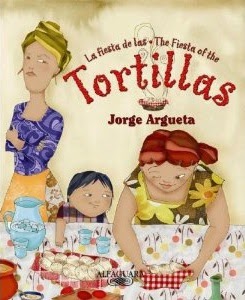
Review: Jorge Argueta's La Fiesta de las Tortillas

Teachers!  Parents!  Do you want to make read-alouds as educational and informative as possible for your kids?  I'm starting a series of book reviews in which I provide tips for using diverse picture books in the classroom (or at home).  I hope you enjoy them!

Title: La Fiesta de las Tortillas / The Fiesta of the Tortillas
Author: Jorge Argueta (El Salvador)
Illustrator: María Jesús Álvarez (Argentina)
Translators: Joe Hayes & Sharon Franco
Publisher: Alfaguara
Age range: 5+


Who doesn’t love food and a good mystery?  In La Fiesta de las Tortillas / The fiesta of the tortillas, USBBY and Américas Book Award winner Jorge Argueta draws from his childhood experiences to serve up a charming, semi-autobiographical “story full of magic and flavor” (p. 2).  Koki’s family owns a restaurant in rural El Salvador, and each day his aunts and cousins make fresh tortillas for their customers.  One night Koki’s Aunt Toya hears a rhythmic clapping – the sound of someone cheerfully preparing tortillas – coming from the empty kitchen.  

The next day, she asks her sister Rosa about the clapping, and Rosa confirms that she has also heard the mysterious noise.  Each night, the rhythm awakes a different family member who stumbles into the kitchen only to find it dark and empty.  After days of confusion and concern, the women finally realize that the Spirit of Corn has been visiting them.  They embrace the cheerfulness and warmth of the Spirit and get to work together, singing a tortilla-making song they enjoyed when they were younger. 

This side-by-side bilingual text is an excellent support for emergent bilingual children.  Argueta tells his story with delicious, descriptive Spanish imagery, blending rich figurative language, preterit and imperfect verb tenses, and a large helping of food vocabulary (loroco, pimiento, masa, tamales, huevos, frijoles).  A native of El Salvador, Argueta also introduces readers to Salvadoran and Central American vocabulary, like comedor (restaurant), pizcucha (kite), resortera (slingshot), and pupusa (stuffed tortillas).  


Since the language is complex, Joe Hayes’ and Sharon Franco’s English translation below the Spanish text can help young Spanish learners find their way through difficult passages.  María Jesús Álvarez’ intricate illustrations – a combination of earth-toned watercolor and photographic collage that pops with bright blues, reds, and yellows – also reflect and reinforce the text, providing readers with an excellent visual aid.


This book is also replete with cultural information that provides children with an engaging introduction to learning about the Pipil Nahua people, the indigenous group to which Argueta belongs.  Because of the relative absence of indigenous American voices in media and public discourse, many non-indigenous children are unaware that native peoples are still around today, much less that some people of indigenous heritage, like Argueta, still participate in their communities’ traditional beliefs and cultural practices (as evidenced by the Spirit of Corn in this book).  Therefore, La Fiesta de las Tortillas can ease children into a deeper knowledge about the presence of indigenous people in Central America, particularly the Pipil Nahua in El Salvador.  Please see the following links for additional resources:

Interview with Jorge Argueta (Spanish)

Interview with Jorge Argueta (English)

Additional information on Pipil Nahua history, culture, and current events

List of Jorge Argueta's books on Goodreads