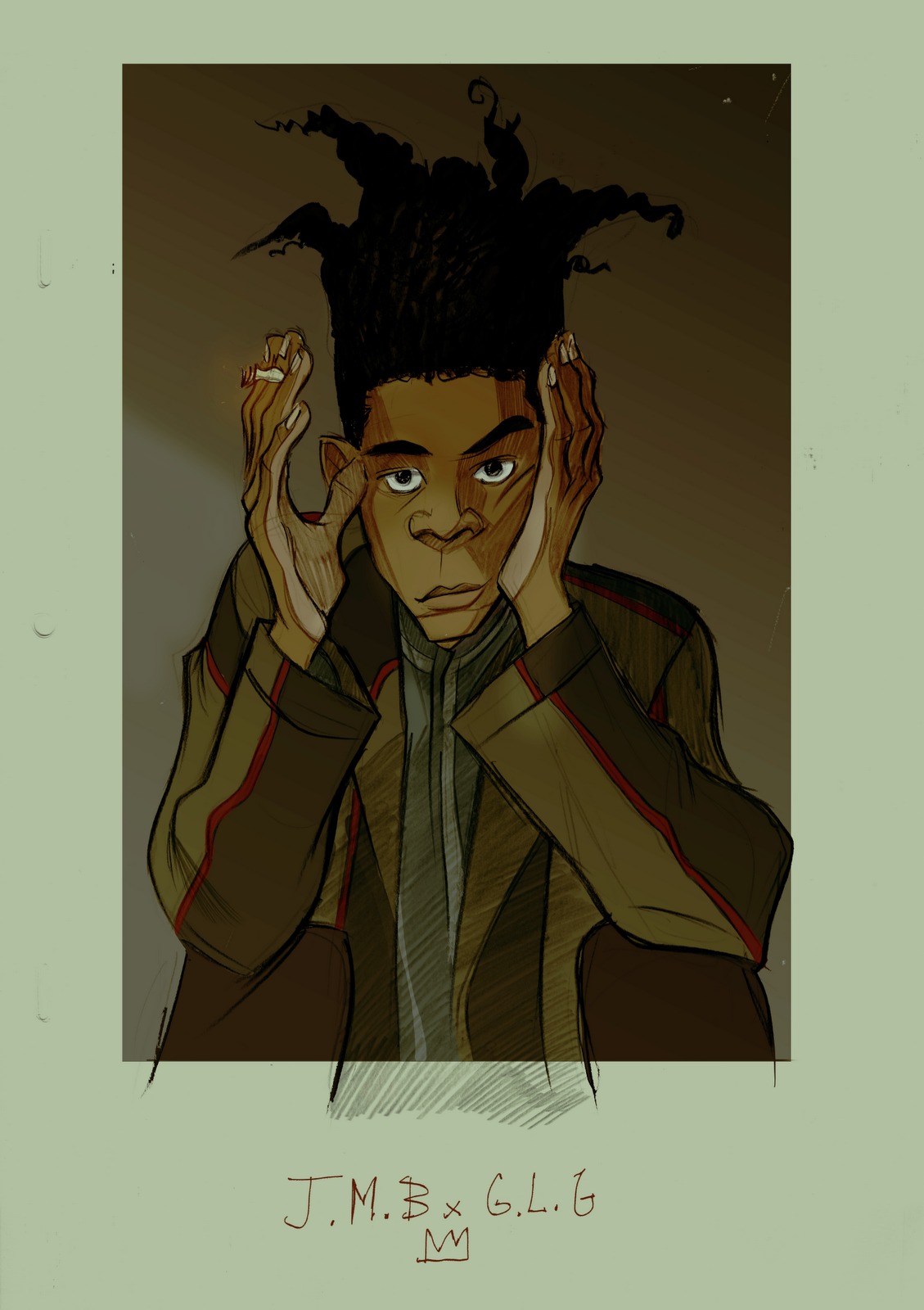
This week's illustrator is Gyimah Gariba, who grew up in Ghana and currently lives and works in Toronto. Instead of writing a description, I'll let him speak for himself:
To my eye, his style looks like comics + mural art + watercolor = a really fresh and interesting blend that's different from anything else out there. If you'd like to keep track of his daily doings, he has great Instagram and Tumblr accounts where he posts his art frequently. In the meantime, here are some of his pieces:
Mr. Gariba is also an animator. Until recently, he worked on the Adult Swim show, Black Dynamite, and now he's apparently developing a slightly mysterious animation project called Anansi. I haven't been able to find much information about it, but here are some character shots from his website:
I'm intrigued! But here's the thing -- as far as I can tell, Mr. Gariba has never illustrated children's books. I would love to see his style in the pages of a picture book, so, if he's interested in that kind of work, we might see some of that in the future. Here's hoping!
This week's illustrator is Jing Jing Tsong! Ms. Tsong lives in Hawaii with her husband, Mike Austin, who's also an illustrator. According to their website, her artistic technique combines printmaking with digital illustration, and she focuses heavily on multicultural subject matter. In addition to creating art for children's books, she also does some advertising and stock image work.
I love how she fills her crisp lines with so much color and pattern, making her images clean yet nuanced. Plus, her style is SO CUTE:
If you're interested in taking a look at some of her books, I've compiled a list below. The first four are board book written and illustrated by Ms. Tsong, and the following three are collaborations with other authors. I'm particularly excited about Shanghai Sukkah, which is the story of a Jewish boy who escapes the Nazis and relocates to China with his family. It releases in August 2015, so we don't have to wait too long for it!
This week's illustrator is Zineb Benjelloun! Ms. Benjelloun hails from Morocco, attended university in France, and currently lives in Casablanca. According to an interview with OkayAfrica, inspiration comes from the world around her and is influenced by her work in television and documentary film-making. Another major influence is her desire to explore her Moroccan identity and to depict real Moroccan people as diverse individuals "in the international visual landscape" (as cited in Sefa-Boakye, 2015) -- an important task considering the stereotyped, essentialized representations of Moroccans (and Africans in general) floating around in illustrations and texts created by outsiders.
Here are a few examples of her work from her website:
I love how she uses seemingly simple line work to create extraordinarily complex visions. There's something so appealing about the geometry of her pieces -- whether she uses color or keeps things black-and-white, her images grab the eye and hold it.
Also, Ms. Benjelloun has created art several online books for children for a website called eMadrassa. These books feature animated illustrations, sound effects, and text that changes color as the words are read aloud by an audio reader -- very cool! The only catch is that the books are in French, but don't let that stop you from checking them out. And if you know any children who speak French or are learning, then these books can be a very helpful resource, not only for their language development, but also for learning about culture, history, science, and more:
Sauvons notre patrimoine (children learn about remembering Moroccan history and culture by preserving architecture)
Des animaux pas bêtes (a class learns about animals and conservation during a trip to the zoo)
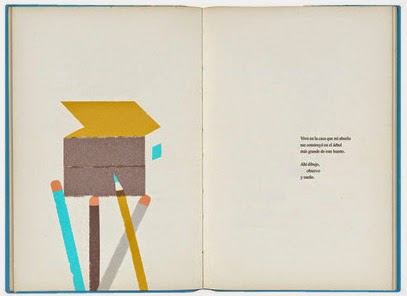
This week's illustrator is Manuel Monroy! Mr. Monroy received his degree in graphic design from la Universidad Autónoma Metrpolitana in Mexico City and has created art for children's books, magazines, advertisements, and animations for the past twenty years. During that time, he's also won multiple awards and has shown his work in exhibits around the world. Here's a sampling of his artwork from his website:
His images are all about balance -- they're soft yet expressive and combine earth tones with pops of bright color. Also, they're just so dang cute, soothing, daydream-y, and perfect for picture books. If you'd like to add some of his illustrations to your home or classroom library, hit the links below:
Well, it's summer break (according to my school calendar), so I'm on vacation. HA right, I'll be spending the next few months going to friends' weddings, going to my own wedding, taking a three-week intensive class, and reading for comps, meaning that I'll have to take a break from my (not really) strict blogging routine.
via quickmeme
However! Since this blog is one of the ways I stay sane, I'll still post. Instead of my usual fare, though, I'll be keeping things light and easy by posting "Illustrator of the Week" pieces. Picture book art is one of my favorite things about children's literature, so I'm going to celebrate a different illustrator every week (or so) in order to introduce you to or remind you of great artists from diverse backgrounds.
I'll start this week with an illustrator from -- surprise surprise -- Mexico, so stay tuned!
My parents are celebrating their 47th wedding anniversary today, and everyone knows that the traditional gift for a 47th anniversary is a children's book review from the couple's weird PhD student daughter, so here you go, Mom and Dad!
(According to this website, the "modern" gift for 47 years is books, so this is working out better than expected.)
This week, I'm reviewing a sweet book that reminds me of my parents, who met in first grade, grew up together, dated in high school, broke up when they went to different colleges, reunited a couple of years later, got married, and eventually wound up with me.
Cecilia and Miguel Are Best Friends / Cecilia y Miguel son mejores amigos, a dual language picture book by San Antonio natives Diane Gonzales Bertrand and Thelma Muraida, presents a similar story. In third grade, Cecilia and Miguel begin a friendship that weathers various challenges and frustrations. Readers watch as the duo grow up and remain close, even when Cecilia excels at fishing while Miguel tangles and breaks his line, Miguel wins a bike race and Cecilia has to quit due to flat tires, and they play for different teams in high school. Eventually, the two go off to different colleges, but even distance can't keep them apart -- they marry and later have twins, who love to look at their parents' photographs and hear the story of the friendship that created a family.
Everything in this book just fits. I love how Thelma Muraida frames her warm, gentle illustrations in jagged photograph borders so that each page becomes an entry in the scrapbook that Cecilia and Miguel share with their children. I love how Miguel gives Cecilia bunny ears in their third grade class picture, only to get bunny ears himself in their formal wedding portrait.
That's what you get, Miguel ;)
I love how Diane Gonzales Bertrand includes several common Mexican-American cultural practices that remind me of growing up in Texas -- piñatas, cascarrones, quinceañeras. And I love how the story emphasizes how friendship is important in relationships, whether romantic, familial, or platonic. When I have kids, I'll definitely be reading this one to them at bedtime.
Furthermore, teachers of English and/or Spanish learners can use the dual language text to help their students build vocabulary and grammar skills. The words on each page follow the same pattern: "Cecilia and Miguel are best friends, even when... / Cecilia y Miguel son mejores amigos, aun cuando..." Reading these repetitive phrases throughout the book can allow children to internalize these words and grammatical structures, making it easier to understand them and even use them in conversation and writing.
So if you're looking for a last-minute holiday gift for a child or teacher, consider Cecilia & Miguel -- it's the perfect addition to a home or classroom library. Enjoy!
I love the World Cup. No, I don't think you understand. I LOVE IT.
From June 12th to July 13th, I'll be watching as many games as possible while still trying to function in other areas of my life. There's a lot to love about this tournament: the soccer itself, the sportsmanship, and the way it brings the world together in celebration.
2006 Ivorian (Côte D'Ivoire) national football team
However, beneath all the World Cup's fanfare lurk some disturbing problems.
At the forefront is the issue of racism in soccer at local, national, and international levels. Sadly, players of color are often racially harassed by fans, other teams, and even their own teammates. One especially notorious type of harassment involves fans making monkey noises at black players and throwing bananas on the field. Yes, that kind of thing still happens.
Dani Alves eating a banana thrown onto the field --
in your face, racist fan.
Unfortunately, though, these measures don't always stop racist actions. Brazil, this Cup's host country, has its own "We Are Equal" campaign, but this message of tolerance and diversity has not made a dent in the problem.
So what does this have to do with kids and education?
In The Land of Teaching, it's a well known fact that incorporating students' personal interests into the curriculum can help them become more engaged in learning. Do you have any students who love soccer? Then appealing to that interest and helping them develop critical thinking skills by examining these soccer-related problems might result in their finding a social justice cause that really appeals to them.
For example, younger kids could discuss racism in soccer, since that's a concept they can wrap their heads around -- disliking and harassing people because of their skin color and/or ethnicity is wrong. Then they could come up with ways to address the problem, like starting their own anti-racism club at school or camp, or writing letters of support to players who have taken a stand against racism.
Meanwhile, high schoolers could also focus on racism or, if they're up for it, tackle some of the other challenges Brazil has been facing while preparing for this World Cup. I wonder what kinds of great ideas they might come up with.
Long story short:
Enjoy the World Cup, but take the time to learn about the darker side of soccer that The Powers That Be so often try to cover up. Confront problems. If possible, support kids in doing the same. Only then can we truly celebrate.
We had a great celebration yesterday with the families in our community, and the kids got to take home two books each.
Our party was carnival themed with craft and game stations, each inspired by a different bilingual or multicultural book. Kudos to the organizer for coming up with such great ideas! Here are some examples:
Día de los Niños / Día de los Libros is Thursday, April 30th this year. Check here to see if your local library has any Día celebrations planned during the next few days!
Día began in 1996, when the marvelous children's author Pat Mora decided to bring El Día de los Niños -- Children's Day, a Mexican tradition -- to the US and add the element of "bookjoy," or love of the written word. Now we observe Children's Day / Book Day every year on the last day of April with community festivities and lots of reading.
Pat Mora's Book Fiesta -- read it!
If you'd like to find a Día celebration near you, check out the American Library Association website and just enter your zip code. I'm going to be celebrating with some kiddos I work with, so I'll be sure to post pictures of our event next week.
Because this tradition originated in Mexico, I want to let y'all know about two of my favorite Mexican picture books that I'll be bringing to our Día party. The first is Girando la Vida, written by Fiona del Mar and illustrated by Claudia de Teresa, a colorful, dreamy book about the motion of life.
Then there's Domitila y el Mar, by Nina Basich and Teresa Martínez, about a woman who's always busybusybusy but finally succumbs to relaxation by the sea.
These books just make me feel good. And they're great for kids who already speak Spanish or are learning Spanish! If you'd like your own copies, you can purchase them (either straight from the publishers or possibly on Amazon) and keep them for yourself or donate them to your local school or library.
Happy National Library Week! I want to pay a tribute to all of the libraries that have made a difference in my life over the years, so here we go:
I'll start with my elementary school library, where Mrs. Rosencranz -- our wonderful librarian who did great read-alouds and wore lots of perfume -- encouraged my love of non-fiction. It's also where I discovered my first Most Favoritest Book, Secrets of the Mummies by Joyce Milton -- I checked it out year after year after year, from Kindergarten all the way through fifth grade.
Complete with terrible black-and-white photographs
Next is Kendall Branch Library, part of the Houston Public Library system. (They just built a gorgeous, light-filled new home, which is fantastic because the building I grew up with was pretty dang ugly.) Anyway, this library saved me from boredom every summer and also provided me with great sources for school projects.
Old Kendall: gross.
New Kendall: yay!
Then comes the Davidson College Library, home of avocado green carpet and orange pleather chairs -- we were convinced that those colors helped us concentrate better. In this library, I discovered the wonders of interlibrary loan and researched and wrote a paper on The Canterbury Tales in twelve hours the day before it was due (got an A, boo ya). While studying for finals there one semester, a friend and I fell into giggle fits after considering prank-calling our philosophy professor and pretending to be the ghost of René Descartes. Also of note: random, mysterious trails of gummy bears. See, libraries are fun!
Then they ripped up our beloved puke green carpet (seen here in patches) and put down "tasteful" blue carpet :(
And finally, there's the Athens Regional Library System. Our main library is a cheerful place that draws people from all over the community, and they ALWAYS have what I need. Most recently, I checked out Sherman Alexie's Absolutely True Diary of a Part-Time Indian, and I'm so grateful that I finally read it.
So that's my hopefully-not-too-boring account of the libraries that have made my world brighter.
What are some of your favorite library memories? Go visit your favorite biblioteca this week and hug a librarian! Also, consider volunteering or making a donation -- libraries do so much good for so many people, so let's give them our support!
It's not perfect, but it's a huge step forward -- and it's wonderful that districts now have the explicit support of the Board of Education. Hopefully, students will now have better access to courses on Mexican-American, African-American, Native American, and Asian-American Studies as electives.
As I've mentioned before, my youthful experiences with history focused pretty much -- with token exceptions -- on white European-American people and events, and, as you know, this trend continues today all over the country. These courses will ideally allow any kid, regardless of ethnic background, the opportunity to learn about how people from different ethnicities and cultures contributed to our nation's history. Because Mexican-American, African-American, Native American, and Asian-American history IS EVERYBODY'S HISTORY.
All in all, I'm excited to see what kinds of textbooks and materials the publishing companies submit to the Board of Education -- hoping for some great stuff!