Showing posts with label nonfiction. Show all posts

Tuesday, March 17, 2015

GCBA 2015!

Every year, UGA's College of Education hosts the Georgia Children's Book Awards and Conference on Children's Literature (or GCBA), an exciting, informative gathering that brings together authors, illustrators, teachers, librarians, and, happily, grad students.  In case you didn't know, I love smaller conferences because they provide great opportunities to spend time with friends, meet new people, enjoy interesting presentations and workshops, and just savor a nice weekend.


A lot happens at the conference, including the announcement of the year's award-winning picture book (grades K-4) and chapter book (grades 4-8).  Students and teachers around the state vote for their favorite books, and this year's picture book winner was Ol' Clip Clop: A Ghost Story, written by Patricia C. McKissak and illustrated by Eric Velasquez -- no big surprise, since lots of kids love spooky tales.  (I wish Niño Wrestles the World had won, but we can't have everything we want.)

The highlight of the conference for me, though, was meeting artist/author Shonto Begay and hearing him speak about his experiences growing up in Arizona, attending the Institute of American Indian Arts in Santa Fe, and creating sumptuous paintings that capture the desert, Navajo cultural practices, his family and neighbors, and the "harsh realities of modern reservation life."  His art is "about praying, about sending out a universe of prayer," he said, and each swirl of color is "the visual representation of a chant, the syllables of prayers."  And he can Etch-a-Sketch like no other.


Mr. Begay also discussed his time at a boarding school -- school officials literally kidnapped him while he was tending his family's sheep and took him to the "brutal institution," where government teachers attempted to "cleanse" children of their language, religion, and cultural identities.  While he didn't go into much detail about his "educational" experiences, Mr. Begay did emphasize that these schools left "a whole generation traumatized" and that his time there greatly influenced his work.  The tragedies of Indian boarding schools are so often ignored by history, so I'm grateful that he shared his memories.  We need to confront this past, even if it's painful.

Later that day, I found a treasure in the bookstore (because yes, this conference has a bookstore!) -- Navajo Long Walk, illustrated by Mr. Begay and written by Joseph Bruchac.  A counter-narrative to the glorified story of European-American westward expansion, this book privileges the Navajo perspective on the Long Walk, a 450-mile forced march from a reservation in Arizona to the Bosque Redondo in New Mexico.


I've been studying depictions of American Indians in nonfiction children's books and have observed that the telling of American Indian histories is dominated by White historians (Wilson, 1996).  Traditionally, it's been somewhat difficult to find histories written and/or told by Native people about their own tribes and nations.  Furthermore, books about American Indians written by non-Native authors are often filled with harmful stereotypes, biases, oversimplifications, and generalizations (Noll, 1995; Reese, 2007) -- either that, or authors romanticize Native people, minimizing their humanity by depicting them as magical, "relentlessly ecological," noble savages (Slapin, Seale, & Gonzales, 1996, p. 20; Stewart, 2000).  Navajo Long Walk, however, is a history created by two Native people and gives voice to people who have long been silenced while avoiding stereotypes.  Highly recommended.

If you're interested in exploring Shonto Begay's other children's books, take a look at this Goodreads list.  Have fun!

References

Noll, E. (1995). Accuracy and authenticity in American Indian children’s literature: The social      responsibility of authors and illustrators. The New Advocate, 8(1), 29-43.

Reese, D. (2007). Proceed with caution: Using Native American folktales in the classroom. Language Arts, 84(3), 245-256.


Slapin, B., Seale, D., & Gonzales, R. (1996). How to tell the difference: A guide for evaluating children’s books for anti-Indian bias. Sonoma, CA: Oyate.

Stewart, M. P. (2000). How can this be Cinderella if there is no glass slipper? Native American    “fairy tales.” Studies in American Indian Literature, 12(1), 3-19.


Wilson, A. C. (1996). American Indian history or non-Indian perceptions of American Indian       history? American Indian Quarterly, 20(1), 3-5.

Monday, February 23, 2015

Review: Nina Shor's Arte Popular

Title: Arte popular: Búscalo y encuéntralo (Folk Art: Look and Find)
Author: Nina Shor (Mexico)
Illustrator: Various artists (Mexico)
Publisher: Ediciones El Naranjo
Ages: 6+


The children's literature library in my university's education building has a great, growing collection of Spanish and dual language books, and I first noticed this title on the New Arrivals shelf a few months ago.  I love me some traditional arts and crafts and was curious to see what was inside, but I didn't have any time to stop and look at the book, so I left and forgot about it.

Until I saw the same book in that magical bookstore in Puebla and snatched it right up.

Arte popular is a treasure trove of Mexican folk art.  Each section of the book contains a different type of art from a particular region.  Large, detailed photographs, interviews with artists and craftspeople, and information about each art form's history and functions show readers how diverse and useful art can be.  For example, readers will learn that art can:

Be clothing (like huipiles in Oaxaca)

Depict religious beliefs and understandings 
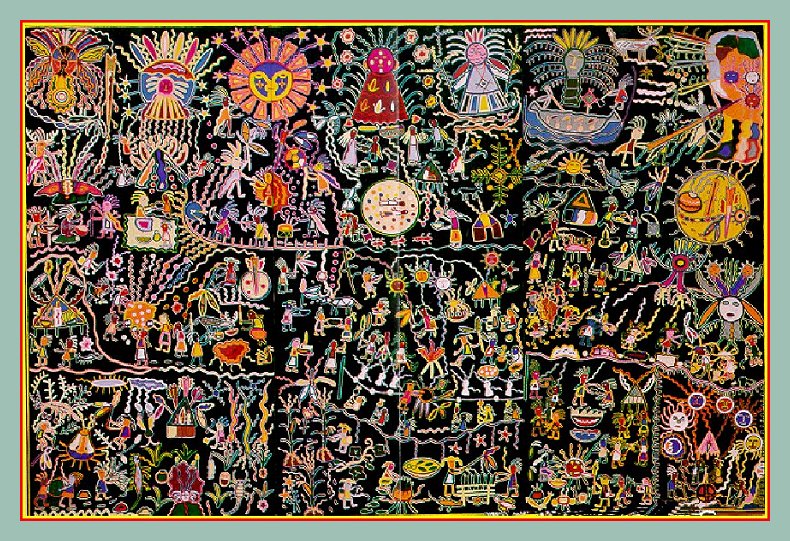
(like Huichol tapestries in Nayarit, Jalisco, Durango, and Zacatecas)

Help people observe special occasions (like papel picado in Puebla)

Before introducing each art form, Nina Shor encourages readers to examine each work closely by providing them with a list of details to search for as well as questions to consider.  This challenge makes the book more interactive and asks children to think more deeply about what they're seeing.

Since the text is in Spanish and intended for more advanced readers, younger and/or monolingual English-speaking kids might need adult assistance when gleaning information from this book.  Children can certainly enjoy the artwork on their own, but their experiences with this book will be so much richer if they can access the text and learn about the meanings behind the photographs.  Therefore, I would recommend Arte popular to Spanish, dual language, Mexican American Studies, and Spanish-speaking art teachers.  Or, if you don't speak Spanish but know someone who wants to help you translate, go for it!  This book is too good to pass up.

Tuesday, November 25, 2014

Dismantling the Thanksgiving Myth: Helpful Links

As I've mentioned before, I was terrified of angering parents when I was a classroom teacher.  Because of this fear, I shied away talking about anything controversial with my students -- including Thanksgiving.  I've known for a long time the mythical nature of the United States' beloved Thanksgiving story, but since I didn't want to be accused of "playing the race card" or "harming children's innocence," I avoided the Pilgrim-and-Indian story altogether.

None o' this.

Instead, I focused on the basic practice of being thankful.  There are some great books out there that focus on gratitude without dragging in the Thanksgiving myth -- my personal favorite is Pat Mora's Gracias/Thanks, a wonderful reminder to be thankful for the little things in life.  Also, my students and I made "We Are Thankful for..." books.  It was a great time.

However, while there's nothing wrong with emphasizing gratitude (which, after all, should be the focus of such a holiday), I see now that simply ignoring the Thanksgiving myth won't make it go away.  Even if we educators don't actively perpetuate the story at school, kids will pick it up somewhere else from popular media that often portrays an incorrect, racist version of the Pilgrims' arrival in Plymouth.


So in addition to celebrating gratitude, it's important to dismantle the legend so that kids don't internalize false, harmful information about Thanksgiving.  I know it's a little late to talk about the holiday in schools, but it's never too early for teachers to start planning discussions and activities for next year, and parents still have time to address these issues with their children at home.

And if, like me, you're at a loss for strategies to begin critical discussions of the Thanksgiving myth, check out these links:


I hope you have a warm and safe holiday, and, as always, let me know your thoughts on critical literacy topics like this one!

Tuesday, November 18, 2014

Review: Amalia Astorga's Efraín of the Sonoran Desert

Title: Efraín of the Sonoran Desert
Authors: Amalia Astorga (Mexico), as told to Gary Paul Nabhan (US)
Illustrator: Janet K. Miller (US)
Publisher: Cinco Puntos Press
Age range: 6+


It's Native American Heritage Month, and while we we're hopefully considering Native American issues (both historical and contemporary) year-round, it's a good time to collectively focus on the diversity and contributions of indigenous Americans to within their communities and larger society.  (And by "Americans," I mean North and South Americans.)

Therefore, I'll be taking a look at a book I've been wanting to review for a long time -- Efraín of the Sonoran Desert.  This book tells of the Seri people (or Comcaac, as they call themselves) of northern Mexico and their relationship with endangered local lizards.  


In an introduction, famed ecologist Gary Paul Nabhan shares a story about a visit to a Comcaac town, where he notices that several species of endangered lizards are thriving around the people.  His curiosity leads him to ask a local woman, Amalia Astorga, what she knows about the animals.

At this point, Astorga assumes the role of narrator and tells the tale of her friendship with Efraín, a lizard she nurtured for seven years.  It becomes clear that the Comcaacs' care for local animals is helping them thrive while habitat destruction in other parts of the desert is endangering all kinds of wildlife.

Overall, I have mixed feelings about this book, but I'll start my review with what I like.  First, I like that Astorga shares her own story -- she's even listed as the author of the book.  Since the dominant culture so often silences the voices of indigenous people, it's wonderful to see that Astorga's voice is included here.  Her story matters.

Second, I like how this book privileges the Comcaac people's views on conservation.  In the Americas, our way of "doing science" is heavily influenced by European-style research and practice.  We tend to trust knowledge backed up by intricate instruments, the scientific method, and peer-reviewed studies -- not that there's anything wrong with that.  Meanwhile, however, we often dismiss indigenous knowledge, or the various ways that indigenous peoples, like the Comcaac, study and understand the natural world.


In other words, we've been socialized to trust the word of a college-trained ecologist like Gary Paul Nabhan -- an outsider who has spent relatively little time in the Sonoran desert over the word of a woman like Amalia Astorga -- who has spent her life interacting with the animals in her local environment.  Therefore, it's a relief to read Astorga's own words, to hear her ideas and understandings.

Lastly, I like how Nabhan describes how the Comcaac people are in charge of their lives and their contemporary situation without casting them as victims or noble savages.  Their population is small, and there are pressures to assimilate into "mainstream" Mexican society, but these people aren't doomed.  Instead, adults "are actively teaching their language and traditions to their children so that language loss will never occur in their homeland" (p. 28).  They're real people facing challenges and preserving their cultural practices in the real world.

But.

I find several aspects of this book problematic.  For instance, Astorga's story is sandwiched between several pages of introduction and epilogue from Nabhan.  Why does he have to frame her story?  Do we need a "real scientist" (i.e., someone holding degrees from US universities) to vouch for her?  Why can't we just focus on Astorga's viewpoints?  I'd really rather read her descriptions of her community in addition to her story about Efraín.

Also, I'm uncomfortable with the language Nabhan uses to describe the Comcaac.  First, he calls them "Seri" -- a name given to them by outsiders -- even though the local people prefer to call themselves "Comcaac."  Why not use their actual community name?  Then there's the phrase "endangered people" (pp. 4, 26).  Yes, I understand that he's quoting anthropologists, and yes, many indigenous people's traditional ways of living are under threat, but I just don't like that phrase.  In English, we so often use the word "endangered" to describe species of animals, so I'm not comfortable using that word to label humans.

Finally, I wish the publishers had invited a Comcaac artist to illustrate the book.  Janet K. Miller's illustrations are lovely, but I'd rather see art from the community.

Well, my response to this book is messy, but there it is.  What do you think?  Agree?  Disagree?  Let me know!

Saturday, October 11, 2014

Another Columbus Day Post

I am The Best Artist.

For a different type of Columbus Day critical literacy activity, take a couple of minutes to look through this infographic from Matthew Inman, creator of The Oatmeal.

Done?  OK.

I love infographics, or visual -- almost comic-like -- representations of data or information.  They're fun, easy to process, and a nice break from reading big chunks of text.  Because of their visual nature, they can be very appealing to kids.  Therefore, analyzing infographics can be an interesting, motivating way for students to engage in critical literacy.

Since Columbus Day is upon us, reading and critiquing Matthew Inman's infographic about Christopher Columbus could be a great activity for middle and/or high school students during the coming week.  Teachers and students can tease apart Inman's argument against celebrating Columbus day and discuss how they agree or disagree with his points.

For example, I definitely agree with his argument that Christopher Columbus is not a person worthy of celebration -- he brought a wave of terror to the Americas that still lingers today, and I refuse to honor him and his legacy.


However, I'm not in agreement with Inman's idea to switch the second Monday in October to "Bartolomé Day."  Yes, we should pay more attention to Bartolomé de las Casas and his deeds in history classes, but why should we shift our focus from one European to another?  

Why not focus on indigenous Americans and their history, current events, accomplishments, and diversity -- not just in October but year-round?  (Inman does reference Seattle's Indigenous People's Day, which is not without its own critics, in an update at the bottom of the page.  But it's an afterthought.)

Teachers, how invigorating it would be for students to explore different perspectives on Columbus Day and share their opinions about the holiday and Inman's piece?  Then they might create their own infographics (digital literacy woooo!) to share with each other, their school, and the internet community.

The kids I work with aren't quite old enough to read The Oatmeal, but I'm looking forward to having a nice dialog about Columbus Day with them this week.  But if you have attempted / want to attempt an infographic critical literacy activity like this with your kids, let me know about it!

Monday, September 15, 2014

Review: El Deafo by Cece Bell

After seeing Cece Bell speak at the Decatur Book Festival -- first about diversity in children's literature and later about writing graphic memoirs -- I was really looking forward to reading her new book, El Deafo.


Here's the summary from the back cover: 

"Starting at a new school is scary, even more so with a giant hearing aid strapped to your chest!  At her old school, everyone in Cece's class was deaf.  Here she is different.  She is sure the kids are staring at the Phonic Ear, the powerful aid that will help her hear her teacher.  Too bad it also seems certain to repel potential friends.  Then Cece makes a startling discovery.  With the Phonic Ear she can hear her teacher not just in the classroom, but anywhere her teacher is in the school -- in the hallway ... in the teacher's lounge ... in the bathroom!  This is power.  Maybe even a superpower!  Cece is on her way to becoming El Deafo, Listener for All.  But the funny thing about being a superhero is that it's just another way of feeling different ... and lonely.  Can Cece channel her powers into finding the thing she wants most, a true friend?"

Overall, I enjoyed El Deafo's humor and sensitivity, and I loved Bell's illustration style -- lots of color and clean lines.  Plus, it's wonderful to read a book about a character's experience with (dis)ability that's actually written by a person who has experienced that (dis)ability.

Most of all, I savored the afterword, in which Bell describes the process of writing her memoir and all of the thought and feeling that went into it.  First, she explains the ways in which she tampered with "fact" to make a more readable memoir:

"It’s also important to note that while I was writing and drawing the book, I was more interested in capturing the specific feelings I had as a kid with hearing loss than in being 100 percent accurate with the details.  Some of the characters in the book are exactly how I remember them; others are composites of more than one person.  Some of the events in the book are in the right order; others got mixed up a bit.  Some of the conversations are real; others, well, ain’t.  But the way I felt as a kid – that feeling is all true" (n.p.).

I really appreciate her honesty about the "nonfiction" writing process.  No matter what other writers might tell you, nonfiction is never pure, unadulterated Truth.  Memoir writers aren't really writing about what actually happened -- they're writing about their interpretation of what happened.  Everyone has a different perspective about an event, even if they all witnessed and/or experienced the same thing.  So thank you, Ms. Bell, for being real.

Sounds about right.

Later in the afterword, Bell states: "There are lots of ways to be deaf.  And there is no right or wrong way ... I am an expert in no one's deafness but my own" (n.p.).  She nails an important point there -- we all need to realize that everyone's life experiences are different.  Even if two people seem to belong to the same "culture" (Deaf, African-American, Latin@, European-American, teacher, parent, etc.), their experiences, perspectives, opinions, and values can differ greatly.  When it comes down to it, you are about your own life.

Although I loved these elements of El Deafo, I have some questions about other aspects of the book. At the book festival, Bell said more than once that she chose to use rabbits in her book to make her characters more universal and relatable.  During my time studying children's literature, however, I have read and heard opinions that portraying (dis)abled characters as animals in storytelling can be "othering."  For example, depicting a deaf person as a rabbit in a text, as Bell does, is problematic because it can make that character seem "inferior" and less than human (A. L., personal correspondence, September 14, 2014; Yenkia-Agbaw, 2011, p. 99).

Also, some scholars and fans of popular media culture have found the trope of "portraying [a] character with an impairment as 'extra-ordinary'" to be troubling (Brittain, 2004, n.p.; Cumberbath & Negrine, 1992; Keith, 2001; Quicke, 1985; Saunders, 2000; TV Tropes, 2014).  These critics feel that (dis)abled people should not be seen as less or more than "typically abled" people.  As you can see from the front and back covers of El Deafo, Bell applies this trope to her memoir by presenting her hearing aid as a superpower and herself as a superhero -- someone who is "extra-ordinary" because of her deafness.

Another example = Daredevil

Now for my questions: Is it OK for Bell to use animal characters when portraying her experiences with hearing loss because she's telling her own story and choosing to depict herself this way?  And why did she -- in a book intended to present her experiences with deafness constructively -- align herself with the oft-criticized (dis)abled-character-as-superhero trope?

I'm still processing all of this information, so I don't have any firm opinions.  However, I do like engaging in dialog inspired by provocative questions.  So what do you think?

[Also, many, many thanks to A.L. for sharing her extensive knowledge about representations of (dis)ability in children's literature with me!]

References

Brittain, I. (2004). An examination into the portrayal of deaf characters and deaf issues in picture books for children. Disability Studies, 24(1). Retrieved from http://dsq-sds.org/article/view/841/1016

Cumberbatch, G., & Negrine, R. (1992). Images of disability on television. London, UK: Routledge.

Keith, L. (2001). Take up thy bed and walk: Death, disability and cure in classic fiction for girls. London, UK: The Women's Press.

Quicke, J. (1985). Disability in modern children's fiction. Cambridge, MA: Croom Helm.

Saunders, K. (2000). Happy ever afters: A story book guide to teaching children about disability. Stoke-on-Trent, UK: Trentham Books.

TV Tropes. (2014). Disability superpower. Retrieved from http://tvtropes.org/pmwiki/pmwiki.php/Main/DisabilitySuperpower

Yenkia-Agbaw, V. (2011). Reading disability in children's literature: Hans Christian Andersen's tales. Journal of Literary & Cultural Disability Studies, 5(1), 91-108.