Showing posts with label social media. Show all posts

Friday, October 24, 2014

Looking for Great Multicultural Titles? Try Pinterest.


Last week, I attended the UGA College of Education's Innovations in Teaching Conference and had the great fortune of sitting in on a presentation by Meg Hines of the Educational Psychology department.  Dr. Hines shared information on how teachers can use Pinterest as a tool for online discussions with students, and her presentation got me thinking about using Pinterest as an educational resource -- especially for educators and parents who want to learn more about quality multicultural children's literature and pedagogy, as well as teachers who might want to use Pinterest in their middle/high school or college classrooms.

Immediately after the presentation, I logged into my Pinterest account (which has been collecting dust for about a year) and started searching for pins and boards focused on diverse children's literature.  You might be thinking, "Duh Marianne, everyone knows that you can find lots of educational stuff on Pinterest."  But I had no idea there were so many good recommendations and resources for kids' books, critical literacy, and multicultural education!

oooooh

I discovered lots of great boards like these:


Also, I decided to go crazy and start some of my own:


If you're a teacher, you might even consider starting a board for your class (middle/high school or college) so that your students can pin their own book recommendations and write evaluations of the books in the captions.  Here are some possible steps:

1) Get your students set up with Pinterest accounts.

2) Go to your profile page and click "Create Board."


3) Fill in the details for the board.  At the bottom of the "Create a Board" window, you can add your students to the list of people who can use the board.  You can even click "Keep It a Secret" if you don't want your board to be public.


4) Once you've added all of the students to the board, they can go in, upload a pin about a book, and write their evaluation in the pin's description box.


Have fun exploring!  And if you find/make/have good multicultural education boards, or if you use or have used Pinterest in your classroom with students, let me know about it!


References

Hines, M. E. (2014, October). On using Pinterest to create online visual discussion forums. Presentation at the Innovations in Teaching Conference, Athens, GA.

Tuesday, September 9, 2014

Speaking of the "10 Book" Challenge...


Just saw this article on a colleague's Facebook page.  Facebook's data science team analyzed the "10 Books That Have Never Left Me" lists that FB users posted and found that the most commonly cited works were:

Harry Potter series by J.K. Rowling - 21.08% 
To Kill a Mockingbird by Harper Lee - 14.48%
The Lord of the Rings by JRR Tolkien - 13.86% 
The Hobbit by JRR Tolkien - 7.48% 
Pride and Prejudice by Jane Austen - 7.28% 
The Holy Bible - 7.21% 
The Hitchhiker's Guide to the Galaxy by Douglas Adams - 5.97% 
The Hunger Games trilogy by Suzanne Collins - 5.82% 
The Catcher in the Rye by J.D. Salinger - 5.70% 
The Great Gatsby by F. Scott Fitzgerald - 5.61% 
1984 by George Orwell - 5.37% 
Little Women by Louisa May Alcott - 5.26% 
Jane Eyre by Charlotte Bronte - 5.23% 
The Stand by Stephen King - 5.11% 
Gone with the Wind by Margaret Mitchell - 4.95% 
A Wrinkle in Time by Madeleine L'Engle - 4.38% 
The Handmaid's Tale by Margaret Atwood - 4.27% 
The Lion, the Witch, and the Wardrobe by C.S. Lewis - 4.05% 
The Alchemist by Paulo Coelho - 4.01% 
Anne of Green Gables by L.M. Montgomery - 3.95%


I (and many people I know) read these books for middle/high school English classes, and ALL of the books except for the Bible were written by white people of European descent.  (I think Paulo Coelho is Euro-Brazilian, but correct me if I'm wrong.)

What does this list tell us about the people who took part in the challenge and about books are commonly assigned in schools?  What does it tell us about books that sell well and are widely read?  This is great data that can feed the discussion about diversity in the world of literature.  Just some food for thought!

Friday, May 2, 2014

#WeNeedDiverseBooks


How beautiful is the We Need Diverse Books campaign?  It's been so cool to get on Twitter and see people from all different backgrounds speaking out for books that reflect the diversity of ethnicity, religion, gender, sexuality, (dis)ability, socioeconomic status, immigration status, and nationality in our world.

If you want to join the Twitter conversation, it's still going on!  Just send out a tweet that goes something like: "#WeNeedDiverseBooks because...."  Get your opinion out there -- I'd like to see how long we can keep it trending.  The Guardian, Salon, and Publishers Weekly (among others) have already put out articles about the campaign, so just imagine the change we can encourage with this attention!  We can create more demand for diverse books among consumers, inspire authors who want to write more diverse works, and show publishers how important this issue is to so many people.


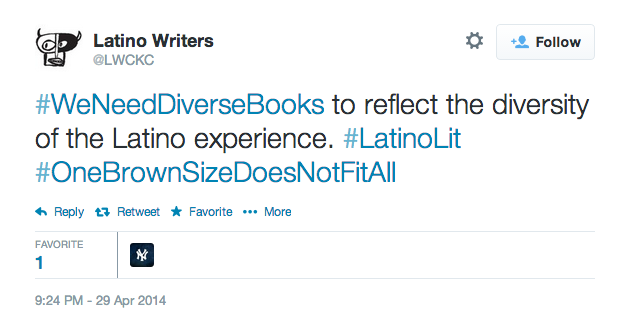
Anyway, here are some of my favorite tweets from the last couple of days.  I'll start with the one that made me tear up:


We shouldn't stop with this social media campaign -- we must continue raising our voices and demanding more diverse children's literature.  Fortunately, there are many ways we can make a difference.  So...

  • Write to publishers -- they are the ones ultimately responsible for what kinds of books are out there.
  • Buy more diverse books published in the US and internationally.
  • Check out diverse books at the library -- circulation matters!
  • Tell friends, teachers, and librarians about your favorites.
  • Read books critically and write reviews.
  • Authors of all backgrounds: keep telling your stories.

Enjoy!