Friday, October 24, 2014

Looking for Great Multicultural Titles? Try Pinterest.


Last week, I attended the UGA College of Education's Innovations in Teaching Conference and had the great fortune of sitting in on a presentation by Meg Hines of the Educational Psychology department.  Dr. Hines shared information on how teachers can use Pinterest as a tool for online discussions with students, and her presentation got me thinking about using Pinterest as an educational resource -- especially for educators and parents who want to learn more about quality multicultural children's literature and pedagogy, as well as teachers who might want to use Pinterest in their middle/high school or college classrooms.

Immediately after the presentation, I logged into my Pinterest account (which has been collecting dust for about a year) and started searching for pins and boards focused on diverse children's literature.  You might be thinking, "Duh Marianne, everyone knows that you can find lots of educational stuff on Pinterest."  But I had no idea there were so many good recommendations and resources for kids' books, critical literacy, and multicultural education!

oooooh

I discovered lots of great boards like these:


Also, I decided to go crazy and start some of my own:


If you're a teacher, you might even consider starting a board for your class (middle/high school or college) so that your students can pin their own book recommendations and write evaluations of the books in the captions.  Here are some possible steps:

1) Get your students set up with Pinterest accounts.

2) Go to your profile page and click "Create Board."


3) Fill in the details for the board.  At the bottom of the "Create a Board" window, you can add your students to the list of people who can use the board.  You can even click "Keep It a Secret" if you don't want your board to be public.


4) Once you've added all of the students to the board, they can go in, upload a pin about a book, and write their evaluation in the pin's description box.


Have fun exploring!  And if you find/make/have good multicultural education boards, or if you use or have used Pinterest in your classroom with students, let me know about it!


References

Hines, M. E. (2014, October). On using Pinterest to create online visual discussion forums. Presentation at the Innovations in Teaching Conference, Athens, GA.

Saturday, October 11, 2014

Another Columbus Day Post

I am The Best Artist.

For a different type of Columbus Day critical literacy activity, take a couple of minutes to look through this infographic from Matthew Inman, creator of The Oatmeal.

Done?  OK.

I love infographics, or visual -- almost comic-like -- representations of data or information.  They're fun, easy to process, and a nice break from reading big chunks of text.  Because of their visual nature, they can be very appealing to kids.  Therefore, analyzing infographics can be an interesting, motivating way for students to engage in critical literacy.

Since Columbus Day is upon us, reading and critiquing Matthew Inman's infographic about Christopher Columbus could be a great activity for middle and/or high school students during the coming week.  Teachers and students can tease apart Inman's argument against celebrating Columbus day and discuss how they agree or disagree with his points.

For example, I definitely agree with his argument that Christopher Columbus is not a person worthy of celebration -- he brought a wave of terror to the Americas that still lingers today, and I refuse to honor him and his legacy.


However, I'm not in agreement with Inman's idea to switch the second Monday in October to "Bartolomé Day."  Yes, we should pay more attention to Bartolomé de las Casas and his deeds in history classes, but why should we shift our focus from one European to another?  

Why not focus on indigenous Americans and their history, current events, accomplishments, and diversity -- not just in October but year-round?  (Inman does reference Seattle's Indigenous People's Day, which is not without its own critics, in an update at the bottom of the page.  But it's an afterthought.)

Teachers, how invigorating it would be for students to explore different perspectives on Columbus Day and share their opinions about the holiday and Inman's piece?  Then they might create their own infographics (digital literacy woooo!) to share with each other, their school, and the internet community.

The kids I work with aren't quite old enough to read The Oatmeal, but I'm looking forward to having a nice dialog about Columbus Day with them this week.  But if you have attempted / want to attempt an infographic critical literacy activity like this with your kids, let me know about it!

Monday, October 6, 2014

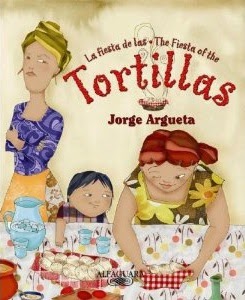
Review: Jorge Argueta's La Fiesta de las Tortillas

Teachers!  Parents!  Do you want to make read-alouds as educational and informative as possible for your kids?  I'm starting a series of book reviews in which I provide tips for using diverse picture books in the classroom (or at home).  I hope you enjoy them!

Title: La Fiesta de las Tortillas / The Fiesta of the Tortillas
Author: Jorge Argueta (El Salvador)
Illustrator: María Jesús Álvarez (Argentina)
Translators: Joe Hayes & Sharon Franco
Publisher: Alfaguara
Age range: 5+


Who doesn’t love food and a good mystery?  In La Fiesta de las Tortillas / The fiesta of the tortillas, USBBY and Américas Book Award winner Jorge Argueta draws from his childhood experiences to serve up a charming, semi-autobiographical “story full of magic and flavor” (p. 2).  Koki’s family owns a restaurant in rural El Salvador, and each day his aunts and cousins make fresh tortillas for their customers.  One night Koki’s Aunt Toya hears a rhythmic clapping – the sound of someone cheerfully preparing tortillas – coming from the empty kitchen.  

The next day, she asks her sister Rosa about the clapping, and Rosa confirms that she has also heard the mysterious noise.  Each night, the rhythm awakes a different family member who stumbles into the kitchen only to find it dark and empty.  After days of confusion and concern, the women finally realize that the Spirit of Corn has been visiting them.  They embrace the cheerfulness and warmth of the Spirit and get to work together, singing a tortilla-making song they enjoyed when they were younger. 

This side-by-side bilingual text is an excellent support for emergent bilingual children.  Argueta tells his story with delicious, descriptive Spanish imagery, blending rich figurative language, preterit and imperfect verb tenses, and a large helping of food vocabulary (loroco, pimiento, masa, tamales, huevos, frijoles).  A native of El Salvador, Argueta also introduces readers to Salvadoran and Central American vocabulary, like comedor (restaurant), pizcucha (kite), resortera (slingshot), and pupusa (stuffed tortillas).  


Since the language is complex, Joe Hayes’ and Sharon Franco’s English translation below the Spanish text can help young Spanish learners find their way through difficult passages.  María Jesús Álvarez’ intricate illustrations – a combination of earth-toned watercolor and photographic collage that pops with bright blues, reds, and yellows – also reflect and reinforce the text, providing readers with an excellent visual aid.


This book is also replete with cultural information that provides children with an engaging introduction to learning about the Pipil Nahua people, the indigenous group to which Argueta belongs.  Because of the relative absence of indigenous American voices in media and public discourse, many non-indigenous children are unaware that native peoples are still around today, much less that some people of indigenous heritage, like Argueta, still participate in their communities’ traditional beliefs and cultural practices (as evidenced by the Spirit of Corn in this book).  Therefore, La Fiesta de las Tortillas can ease children into a deeper knowledge about the presence of indigenous people in Central America, particularly the Pipil Nahua in El Salvador.  Please see the following links for additional resources:

Interview with Jorge Argueta (Spanish)

Interview with Jorge Argueta (English)

Additional information on Pipil Nahua history, culture, and current events

List of Jorge Argueta's books on Goodreads

Tuesday, September 23, 2014

Banned Book Week 2014 Quote Pull


Ahhh sweet, sweet debate.  In honor of acknowledging and evaluating multiple perspectives, here are some different points of view on Banned Books Week, an American Library Association campaign intended to draw attention to the challenging or banning of books deemed inappropriate/offensive.  (If you have time, go ahead and click the links so that you can read the quotes in context.)  Do you agree with Banned Books Week?  If not, what might be a better alternative?

"Banned Books Week brings together the entire book community -- librarians, booksellers, publishers, journalists, teachers, and readers of all types -- in shared support of the freedom to seek and to express ideas, even those some consider unorthodox or unpopular." [American Library Association]


"At the same time the [American Library Association] is propagandizing about banned books, it itself is banning anything that does not promote its agenda." [Safe Libraries]


"Myth: Censorship is usually identified with conservative political or religious groups.  Reality: Examples include the Harry Potter series -- the principal reason, wizardry -- and Tango Makes Three -- the reason, supposed homosexuality of penguins. However, groups not usually identified as conservative also censor. A few years ago, the NAACP unsuccessfully sought to have the Merriam-Webster Collegiate Dictionary redefine the 'N' word and limit it to its offensive connotation. (The publisher refused to limit the definition since over time it has had many different meanings).  Concern has also been expressed regarding the depiction of Shylock in The Merchant of Venice. Some Jewish organizations have challenged its inclusion in the Language Arts curriculum in high schools." [Banned Books Week]
"If library patrons ask for a book to be moved or removed from the children’s section, it’s 'censorship.' If librarians make sure a book never gets there in the first place through a deliberately rigged collection process, it’s 'selection.' Double standards prevail, making librarians look like hypocrites.  It’s a pity that a profession that so upholds intellectual freedom can’t come up with better strategies and arguments than to whine about 'censorship' while effectively doing the very thing they complain about." [The Annoyed Librarian]

"Since there is never anything too stupid if it allows certain government officials to get before a camera or send out a press release claiming they're 'protecting children' from the horrors of the world, you end up with school boards and administrators that give in to pressure. And since no one wants to be against protecting children, that leads to the other set of government officials: those too chicken sh** to speak up and oppose something they know is wrong." [Daily Kos]
"Self-righteous, dissembling librarians are seeking once again to foment 'book-banning' hysteria through their annual dishonest Banned Books Week campaign (Sept. 21-27) sponsored by the self-righteous, dissembling, and politically partisan American Library Association (ALA).  The ALA pursues its hysteria-fomenting goal chiefly by ridiculing parents who, for example, don’t want their six-year-olds seeing books about children or anthropomorphized animals being raised by parents in homoerotic relationships. (Scorn and woe to those parents who hold the now-censored belief that homoeroticism -- even homoeroticism presented in whitewashed, water-colored images -- doesn’t belong in the picture books section of public libraries.)" [Laurie Higgins, Illinois Family Institute]

"[Higgins’] point here is that libraries -- even children’s sections -- aren’t, can’t, and really shouldn’t be ideologically neutral grounds. This is what Higgins would have you believe is her modest, 'common sense' goal; but again, the absence of LGBTQ-affirming books would be, in itself, an ideological choice at this point. No, libraries cannot be neutral, but we should strive to be sure that they are as capacious as possible. I’d argue that there are enough shelves stuffed with the kind of pages Higgins likes already -- we could probably stand to have a few more dedicated to queer-friendly spines going forward." [J. Bryan Lowder, Slate]

Monday, September 15, 2014

Review: El Deafo by Cece Bell

After seeing Cece Bell speak at the Decatur Book Festival -- first about diversity in children's literature and later about writing graphic memoirs -- I was really looking forward to reading her new book, El Deafo.


Here's the summary from the back cover: 

"Starting at a new school is scary, even more so with a giant hearing aid strapped to your chest!  At her old school, everyone in Cece's class was deaf.  Here she is different.  She is sure the kids are staring at the Phonic Ear, the powerful aid that will help her hear her teacher.  Too bad it also seems certain to repel potential friends.  Then Cece makes a startling discovery.  With the Phonic Ear she can hear her teacher not just in the classroom, but anywhere her teacher is in the school -- in the hallway ... in the teacher's lounge ... in the bathroom!  This is power.  Maybe even a superpower!  Cece is on her way to becoming El Deafo, Listener for All.  But the funny thing about being a superhero is that it's just another way of feeling different ... and lonely.  Can Cece channel her powers into finding the thing she wants most, a true friend?"

Overall, I enjoyed El Deafo's humor and sensitivity, and I loved Bell's illustration style -- lots of color and clean lines.  Plus, it's wonderful to read a book about a character's experience with (dis)ability that's actually written by a person who has experienced that (dis)ability.

Most of all, I savored the afterword, in which Bell describes the process of writing her memoir and all of the thought and feeling that went into it.  First, she explains the ways in which she tampered with "fact" to make a more readable memoir:

"It’s also important to note that while I was writing and drawing the book, I was more interested in capturing the specific feelings I had as a kid with hearing loss than in being 100 percent accurate with the details.  Some of the characters in the book are exactly how I remember them; others are composites of more than one person.  Some of the events in the book are in the right order; others got mixed up a bit.  Some of the conversations are real; others, well, ain’t.  But the way I felt as a kid – that feeling is all true" (n.p.).

I really appreciate her honesty about the "nonfiction" writing process.  No matter what other writers might tell you, nonfiction is never pure, unadulterated Truth.  Memoir writers aren't really writing about what actually happened -- they're writing about their interpretation of what happened.  Everyone has a different perspective about an event, even if they all witnessed and/or experienced the same thing.  So thank you, Ms. Bell, for being real.

Sounds about right.

Later in the afterword, Bell states: "There are lots of ways to be deaf.  And there is no right or wrong way ... I am an expert in no one's deafness but my own" (n.p.).  She nails an important point there -- we all need to realize that everyone's life experiences are different.  Even if two people seem to belong to the same "culture" (Deaf, African-American, Latin@, European-American, teacher, parent, etc.), their experiences, perspectives, opinions, and values can differ greatly.  When it comes down to it, you are about your own life.

Although I loved these elements of El Deafo, I have some questions about other aspects of the book. At the book festival, Bell said more than once that she chose to use rabbits in her book to make her characters more universal and relatable.  During my time studying children's literature, however, I have read and heard opinions that portraying (dis)abled characters as animals in storytelling can be "othering."  For example, depicting a deaf person as a rabbit in a text, as Bell does, is problematic because it can make that character seem "inferior" and less than human (A. L., personal correspondence, September 14, 2014; Yenkia-Agbaw, 2011, p. 99).

Also, some scholars and fans of popular media culture have found the trope of "portraying [a] character with an impairment as 'extra-ordinary'" to be troubling (Brittain, 2004, n.p.; Cumberbath & Negrine, 1992; Keith, 2001; Quicke, 1985; Saunders, 2000; TV Tropes, 2014).  These critics feel that (dis)abled people should not be seen as less or more than "typically abled" people.  As you can see from the front and back covers of El Deafo, Bell applies this trope to her memoir by presenting her hearing aid as a superpower and herself as a superhero -- someone who is "extra-ordinary" because of her deafness.

Another example = Daredevil

Now for my questions: Is it OK for Bell to use animal characters when portraying her experiences with hearing loss because she's telling her own story and choosing to depict herself this way?  And why did she -- in a book intended to present her experiences with deafness constructively -- align herself with the oft-criticized (dis)abled-character-as-superhero trope?

I'm still processing all of this information, so I don't have any firm opinions.  However, I do like engaging in dialog inspired by provocative questions.  So what do you think?

[Also, many, many thanks to A.L. for sharing her extensive knowledge about representations of (dis)ability in children's literature with me!]

References

Brittain, I. (2004). An examination into the portrayal of deaf characters and deaf issues in picture books for children. Disability Studies, 24(1). Retrieved from http://dsq-sds.org/article/view/841/1016

Cumberbatch, G., & Negrine, R. (1992). Images of disability on television. London, UK: Routledge.

Keith, L. (2001). Take up thy bed and walk: Death, disability and cure in classic fiction for girls. London, UK: The Women's Press.

Quicke, J. (1985). Disability in modern children's fiction. Cambridge, MA: Croom Helm.

Saunders, K. (2000). Happy ever afters: A story book guide to teaching children about disability. Stoke-on-Trent, UK: Trentham Books.

TV Tropes. (2014). Disability superpower. Retrieved from http://tvtropes.org/pmwiki/pmwiki.php/Main/DisabilitySuperpower

Yenkia-Agbaw, V. (2011). Reading disability in children's literature: Hans Christian Andersen's tales. Journal of Literary & Cultural Disability Studies, 5(1), 91-108.

Tuesday, September 9, 2014

Speaking of the "10 Book" Challenge...


Just saw this article on a colleague's Facebook page.  Facebook's data science team analyzed the "10 Books That Have Never Left Me" lists that FB users posted and found that the most commonly cited works were:

Harry Potter series by J.K. Rowling - 21.08% 
To Kill a Mockingbird by Harper Lee - 14.48%
The Lord of the Rings by JRR Tolkien - 13.86% 
The Hobbit by JRR Tolkien - 7.48% 
Pride and Prejudice by Jane Austen - 7.28% 
The Holy Bible - 7.21% 
The Hitchhiker's Guide to the Galaxy by Douglas Adams - 5.97% 
The Hunger Games trilogy by Suzanne Collins - 5.82% 
The Catcher in the Rye by J.D. Salinger - 5.70% 
The Great Gatsby by F. Scott Fitzgerald - 5.61% 
1984 by George Orwell - 5.37% 
Little Women by Louisa May Alcott - 5.26% 
Jane Eyre by Charlotte Bronte - 5.23% 
The Stand by Stephen King - 5.11% 
Gone with the Wind by Margaret Mitchell - 4.95% 
A Wrinkle in Time by Madeleine L'Engle - 4.38% 
The Handmaid's Tale by Margaret Atwood - 4.27% 
The Lion, the Witch, and the Wardrobe by C.S. Lewis - 4.05% 
The Alchemist by Paulo Coelho - 4.01% 
Anne of Green Gables by L.M. Montgomery - 3.95%


I (and many people I know) read these books for middle/high school English classes, and ALL of the books except for the Bible were written by white people of European descent.  (I think Paulo Coelho is Euro-Brazilian, but correct me if I'm wrong.)

What does this list tell us about the people who took part in the challenge and about books are commonly assigned in schools?  What does it tell us about books that sell well and are widely read?  This is great data that can feed the discussion about diversity in the world of literature.  Just some food for thought!

Thursday, September 4, 2014

10 (Children's and YA) Books That Have Never Left Me

After my last post I need to write about something lighter, so I'm going to indulge in the "10 Books That Have Never Left You" survey.  Usually, I like to convince myself that I'm too grown to participate in social media surveys, but deep down inside I know that part of me loves them.  And this one's book-themed -- I can't resist.  (Although I'm going to focus on children's lit, because duh.)

So here are my ten books.  Whether I read them as a kid or as an adult, they'll always mean a lot to me.

1. Sideways Stories from Wayside School (Louis Sachar)


This book made quite an impression on me when my second grade teacher, Mrs. Davis, read it aloud to us.  Sachar's absurdism definitely influenced my ridiculous sense of humor, and I'll love him forever for that.  Also, I cherish this book (and its sequels) so much that I got a potato tattooed on my toe.  (You'll have to read all of the Wayside School books to figure that one out.)

2. Secrets of the Mummies (Joyce Milton)


I cringe when I think about how horribly outdated this book is (published in 1984, black-and-white photographs) but it still means a lot to me.  Secrets of the Mummies elicits so many wonderful memories -- my discovery of the joys of non-fiction, my beloved Kindergarten teacher and how she encouraged me to pursue my interest in ancient Egypt, and my friends who read this book with me.


3. Charlotte's Web (E.B. White)


Yeah, the story's nice and everything, but the real reason I love this book is because, in third grade, it introduced me to my favorite English word ever: orb.

4. Anno's Alphabet (Mitsumasa Anno)


The illustrations are weird and wonderful, and they helped me learn my ABCs.  Every time I think of this book, I'm transported back to my first childhood home on Marron Court.

5. Chickens Aren't the Only Ones (Ruth Heller)


More non-fiction.  It's also the first book I read aloud to someone other than my parents.

6. I Love My New Toy! (Mo Willems)


I'll never forget how much my Pre-K students laughed whenever I read this one.

7. The Legend of the Poinsettia (Tomie dePaola)


When I was little, Tomie dePaola's books were some of my favorites.  Later, examining the problematic elements of his works were what first drew me into the critical study of picture books.  I have a complicated relationship with this giant of children's literature because I'm simultaneously drawn to the richness of his watercolor illustrations, bothered by his well-intentioned misrepresentation of various cultures, and fascinated by the cognitive dissonance that results in me.

8. Chavela and the Magic Bubble (Monica Brown)


This book contains so much beauty: magical realism, vibrant pictures, and the relationship between the main character and her grandmother.  And now it's even more personally meaningful because now I have a sobrinita who, like Chavela, lives for chewing gum :)

9. Niño Wrestles the World (Yuyi Morales)


Possibly the cutest picture book ever?  It reminds me of my dad, who was really into professional wrestling when he was a rascally little kid.

10. Darkroom: A Memoir in Black and White (Lila Quintero Weaver)


The first graphic novel I ever read!  I appreciate this one because of its atypical (in a good way), refreshing perspective on an important social justice topic, and I'll always associate it with the fantastic time I had at my first children's literature conference.

Well that was fun and gave me all kinds of warm fuzzies.  I encourage you to take a few minutes to remember some books that meant a lot to you when you were little -- it's amazing what kinds of warm memories that children's literature can bring back!