Friday, June 5, 2015

Gyimah Gariba: Illustrator of the Week

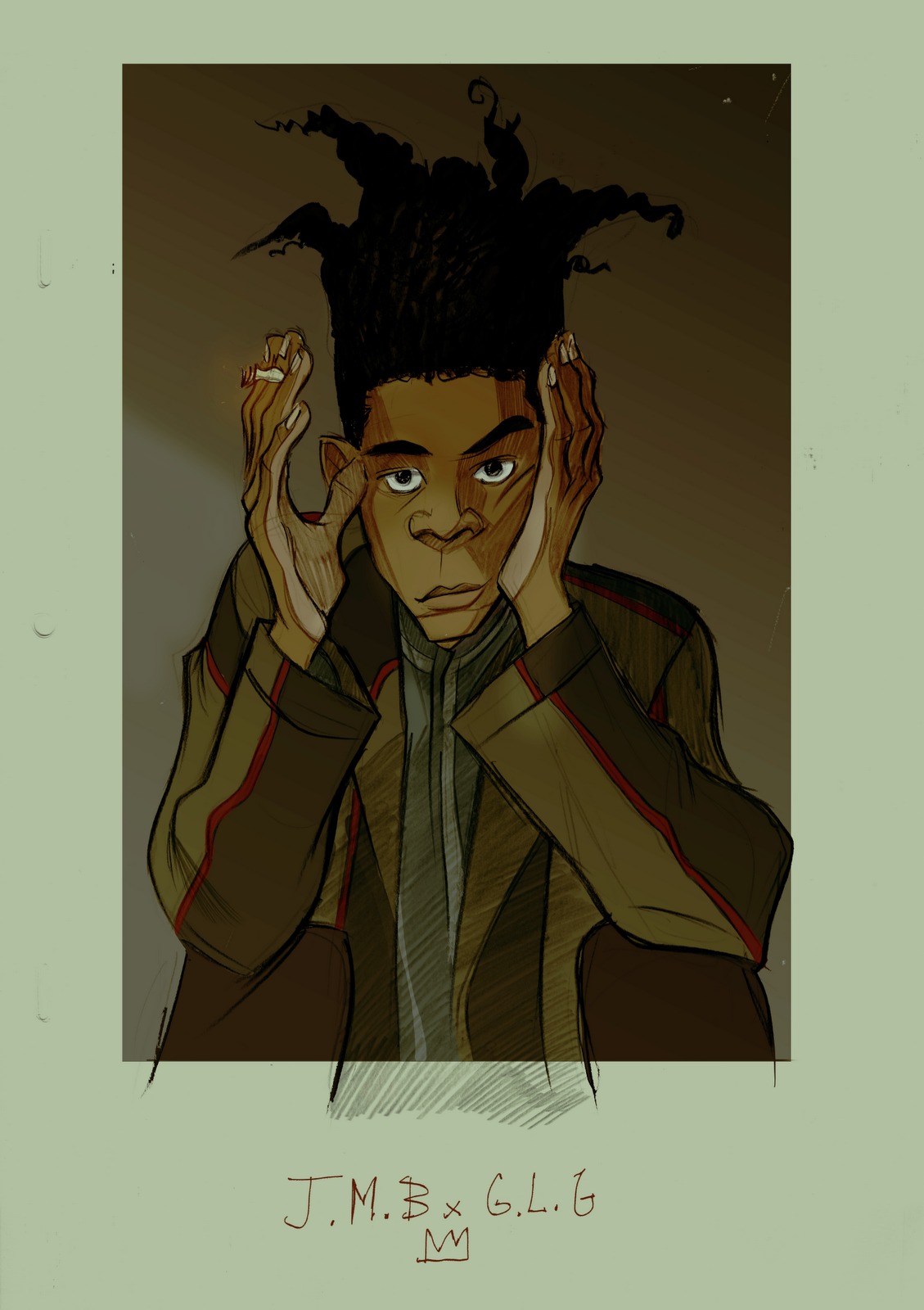
This week's illustrator is Gyimah Gariba, who grew up in Ghana and currently lives and works in Toronto.  Instead of writing a description, I'll let him speak for himself: 


To my eye, his style looks like comics + mural art + watercolor = a really fresh and interesting blend that's different from anything else out there.  If you'd like to keep track of his daily doings, he has great Instagram and Tumblr accounts where he posts his art frequently.  In the meantime, here are some of his pieces:


 "Ghana" (video)


Mr. Gariba is also an animator.  Until recently, he worked on the Adult Swim show, Black Dynamite, and now he's apparently developing a slightly mysterious animation project called Anansi.  I haven't been able to find much information about it, but here are some character shots from his website:
 
 
I'm intrigued!  But here's the thing -- as far as I can tell, Mr. Gariba has never illustrated children's books.  I would love to see his style in the pages of a picture book, so, if he's interested in that kind of work, we might see some of that in the future.  Here's hoping!

Monday, May 25, 2015

Jing Jing Tsong: Illustrator of the Week

This week's illustrator is Jing Jing Tsong!  Ms. Tsong lives in Hawaii with her husband, Mike Austin, who's also an illustrator.  According to their website, her artistic technique combines printmaking with digital illustration, and she focuses heavily on multicultural subject matter.  In addition to creating art for children's books, she also does some advertising and stock image work.

I love how she fills her crisp lines with so much color and pattern, making her images clean yet nuanced.  Plus, her style is SO CUTE:


If you're interested in taking a look at some of her books, I've compiled a list below.  The first four are board book written and illustrated by Ms. Tsong, and the following three are collaborations with other authors.  I'm particularly excited about Shanghai Sukkah, which is the story of a Jewish boy who escapes the Nazis and relocates to China with his family.  It releases in August 2015, so we don't have to wait too long for it!


Up in the Hawaiian Sky (Lavonne Leong)

A Bucket of Blessings (Kabir Sehgal & Surishtha Sehgal)

Shanghai Sukkah (Heidi Hyde)

Happy reading and art appreciating!

Monday, May 18, 2015

Zineb Benjelloun: Illustrator of the Week

This week's illustrator is Zineb Benjelloun!  Ms. Benjelloun hails from Morocco, attended university in France, and currently lives in Casablanca.  According to an interview with OkayAfrica, inspiration comes from the world around her and is influenced by her work in television and documentary film-making.  Another major influence is her desire to explore her Moroccan identity and to depict real Moroccan people as diverse individuals "in the international visual landscape" (as cited in Sefa-Boakye, 2015) -- an important task considering the stereotyped, essentialized representations of Moroccans (and Africans in general) floating around in illustrations and texts created by outsiders. 

Here are a few examples of her work from her website:


I love how she uses seemingly simple line work to create extraordinarily complex visions.  There's something so appealing about the geometry of her pieces -- whether she uses color or keeps things black-and-white, her images grab the eye and hold it.

Also, Ms. Benjelloun has created art several online books for children for a website called eMadrassa.  These books feature animated illustrations, sound effects, and text that changes color as the words are read aloud by an audio reader -- very cool!  The only catch is that the books are in French, but don't let that stop you from checking them out.  And if you know any children who speak French or are learning, then these books can be a very helpful resource, not only for their language development, but also for learning about culture, history, science, and more:

Sauvons notre patrimoine (children learn about remembering Moroccan history and culture by preserving architecture)

Des animaux pas bêtes (a class learns about animals and conservation during a trip to the zoo)

Mille et une répliques (a group of friends puts on a play of 1001 Arabian Nights)

I can't wait to see where Ms. Benjelloun's art takes her -- I hope she keeps illustrating children's books!

Tuesday, May 12, 2015

Manuel Monroy: Illustrator of the Week

This week's illustrator is Manuel Monroy!  Mr. Monroy received his degree in graphic design from la Universidad Autónoma Metrpolitana in Mexico City and has created art for children's books, magazines, advertisements, and animations for the past twenty years.  During that time, he's also won multiple awards and has shown his work in exhibits around the world.  Here's a sampling of his artwork from his website:


His images are all about balance -- they're soft yet expressive and combine earth tones with pops of bright color.  Also, they're just so dang cute, soothing, daydream-y, and perfect for picture books.  If you'd like to add some of his illustrations to your home or classroom library, hit the links below:

What Are You Doing? (Elisa Amado, also available in Spanish)

Why Are You Doing That? (Elisa Amado, also available in Spanish)

Be a Baby (Sarah Withrow, also available in Spanish)

Rooster/Gallo (Jorge Lujan)

Daybreak, Nightfall (Jorge Lujan, also available in Spanish)

When I Was a Boy, Neruda Called Me Policarpo (Poli Delano, also available in Spanish)

Un pueblo lleno de bestias (Francisco Hinojosa)

¿Quién pasó por aquí? (Martha Duhne)

Happy reading!

Sunday, May 10, 2015

Summer Break & Shouting Out Illustrators

Well, it's summer break (according to my school calendar), so I'm on vacation.  HA right, I'll be spending the next few months going to friends' weddings, going to my own wedding, taking a three-week intensive class, and reading for comps, meaning that I'll have to take a break from my (not really) strict blogging routine.

via quickmeme

However!  Since this blog is one of the ways I stay sane, I'll still post.  Instead of my usual fare, though, I'll be keeping things light and easy by posting "Illustrator of the Week" pieces.  Picture book art is one of my favorite things about children's literature, so I'm going to celebrate a different illustrator every week (or so) in order to introduce you to or remind you of great artists from diverse backgrounds.

I'll start this week with an illustrator from -- surprise surprise -- Mexico, so stay tuned!

Sunday, May 3, 2015

Review: Angela Johnson's All Different Now

Title: All Different Now: Juneteenth, the First Day of Freedom
Author: Angela Johnson
Illustrator: E.B. Lewis
Publisher: Simon & Schuster
Age Range: 8+


Attempting to learn about history from a textbook can be a dull, even futile effort.  As social studies education scholar Bruce VanSledright points out in his book The Challenge of Rethinking History: On Practices, Theories, and Policy (2011), textbooks present students with a number of obstacles that can hinder their acquisition of historical knowledge.  First, textbooks often gloss over historical happenings, "condensing rich, complex events into [...] compressed accounts" (p. 39) -- rushed, shallow, paragraph-long blurbs that can't possibly help readers build deep, nuanced interpretations about the past.  Instead, kids need to read various accounts (primary and secondary sources) that present different perspectives about historical events.  When they do so, they learn that history isn't quite as simple as a textbook might present it, and they begin to be able to handle constructively the dissonance that varying points of view can create -- a skill they'll need in the real world, a place full of diversity and sundry ways of being and thinking (Barton & Levstik, 2004).

Another problem with textbooks is that they often present history as a "fait accompli" (VanSledright, 2011, p. 79), a done deal or an open-and-shut account of events that can leave readers bored and wondering whether the past has any relevance in our present lives.  "Why should we care about what happened back then?" they might ask.  "Let's just memorize this boring story and get it over with."  But history has so much more to offer, and utilizing resources like All Different Now -- Angela Johnson's moving poem about a young girl learning on June 19, 1865 that she's free -- invites teachers and students to move beyond the textbook and reclaim the fascinating work of doing history.

What I really love about this book is how it brings the past to life and presents the first Juneteenth as a dynamic, open-ended occasion.  E. B. Lewis' illustrations -- watercolor representations of photographs -- look incredibly realistic, showing readers what people might really have looked like as they experienced their freedom for the first time.  Whereas textbooks often rely on flat, black-and-white photographs to represent the nineteenth century, these images are colorful and alive.  Children can clearly see that slaves were real people who had families, "worked [...] under the hot Texas sun" (Johnson, 2014, n.p.), and felt real joy when they learned about emancipation.


Moreover, Johnson's words and Lewis' illustrations convey to readers that the first Juneteenth and the following years were a complex period in history by implying that, after emancipation, things were "all different now," not "all better now."  Yes, readers will see the people in the book experiencing relief and happiness as they "ate as free people / laughed as free people / and told stories as free people" (Johnson, 2014, n.p.), but they will also see the uncertainty that many people felt as they moved forward into their new lives.  In the last two pages of the book, we read the words "all different now" and see the narrator's family leaving their slave quarters.  Their faces display a variety of emotions -- hope, concern, ambiguity.  While emancipation released Black Americans from the bonds of slavery, it wasn't the end of trouble, and many (if not most) former slaves faced continuing racism and violence.  I like how All Different Now acknowledges this reality and leaves the ending open.  The story isn't over; it's not an open-and-shut chapter in history; it's not a "fait accompli."


Introducing this book in the classroom and constructing lessons around it can provide students with learning opportunities to foster not only their historical thinking skills but also other academic abilities.  Reading All Different Now and other primary and secondary sources about Juneteenth (in addition to or in place of textbook reading) can allow students to compare multiple perspectives about the event, encouraging them to develop a more nuanced understanding about emancipation.  Also, teachers can help students connect past and present by investigating how Juneteenth is celebrated today.  For example, if some students observe this holiday themselves, they can invite family members and friends to teach their classmates more about contemporary celebrations.  Furthermore, engaging with this book can strengthen children's literacy skills (Duke, Bennett-Armistead, & Roberts, 2003).  Encountering new words can build vocabulary (Dreher, 2003), while teachers can encourage students to develop their writing skills by creating their own poetry about a historical event (Ray, 2004).

Juneteenth celebration in Austin, 1900

With all of the great nonfiction and historical fiction children's literature out there, teachers don't have to worry about relying on textbooks.  By welcoming books like All Different Now into the classroom, we can give our students all kinds of wonderful opportunities to connect with the past.

Helpful Resources
  • An article by Henry Louis Gates, Jr., containing several quotations (primary sources) from former slaves about Juneteenth and emancipation
  • Some examples of how Galveston, Texas (where emancipation was announced) celebrates Juneteenth today  

References

Barton, K. C., & Levstik, L. S. (2004). Teaching history for the common good. Mahwah, NJ: Erlbaum.

Dreher, M. J. (2003). Motivating struggling readers by tapping the potential of information books. Reading & Writing Quarterly, 19, 25-38.

Duke, N., Bennett-Armistead, V. S., & Roberts, E. M. (2003). Filling the great void: Why we should bring nonfiction into the early-grade classroom. American Educator, 27(1), 30.

Johnson, A. (2014). All different now: Juneteenth, the first day of freedom. New York, NY: Simon & Schuster. 

Ray, K. W. (2004). Why Cauley writes well: A close look at what a difference good teaching can make. Language Arts, 82, 100-109.

VanSledright, B. (2011). The challenge of rethinking history education: On practices, theories, and policy. New York, NY: Routledge.

Tuesday, April 21, 2015

KidLit in Chicago

I've been yearning to go to Chicago for years now, and I finally got my chance last week when I attended the American Educational Research Association (AERA) annual meeting.  The city did not disappoint!  (I didn't want to leave.  Can I go back now?)  When I wasn't doing conference stuff, I had several opportunities to get out and explore.  Here are some highlights:


Colonial-era painting of La Virgen de Cayma (Perú) @ the Art Institute of Chicago


This looks better than any of the pictures I took.

My favoritefavoritefavorite excursion, however, was visiting the Pilsen neighborhood and the National Museum of Mexican Art on the Lower West Side.  In addition to a beautiful permanent collection -- with everything from Mesoamerican sculpture to contemporary video art -- they have a few temporary exhibits, like the brand new collection inspired by Sandra Cisneros and her landmark novel, The House on Mango Street, which is set in Chicago.


I wish I could've taken pictures of the artwork because the collection included paintings by two of my favorite artists / children's book illustrators: Carmen Lomas Garza and Rafael López.  (Photography isn't allowed in temporary exhibitions at most museums, though.  Oh well.)  Fortunately, there was another Garza painting in the permanent collection, so I snapped a picture of that one:

Las posadas (2000)

Even better, the gift shop had a great selection of Latin@ and Latin American children's books, many of which I'd never seen or heard of before.  One book that really caught my attention was El gusto del mercado mexicano / A Taste of the Mexican Market by Nancy María Grande Tabor.


In this dual language book, Tabor -- who's from Loreto, Mexico -- guides readers through a traditional market, showing them popular Mexican foods and asking questions that reinforce math and science skills (e.g., "If we choose two of each [pastry], how many will we have?" and "Which of these ripe fruits are still green?").  I love this book, not only because of what it teaches, but also because of how Tabor presents the information.  Instead of presenting this Mexican cultural practice as exotic and strange to US readers (as many books about international cultures do, unfortunately), she depicts visiting a market as an interesting (but ordinary) practice that some people do.  Good stuff.

Another great book was Lotería by Patty Rodriguez, a dual language board book by a publisher called Lil' Libros.


Each page spread features a super-cute representation of a lotería card with Spanish and English captions.  Since there are lots of bilingual babies in my life, I bought a copy and was able to test it out on my friends' seven-month-old little dude as soon as I got back to Georgia on Saturday.  He focused intently on each page, laughed when I made Spanish and English rooster noises, waved his chubby little arms, and then shoved the book in his mouth when we finished reading.  So... SUCCESS.

Chicago is a beautiful stronghold of Latin@ (especially Mexican-American) culture, so if you get a chance to visit and are in the market for some great Latin@ children's literature and cultural experiences, they can hook you up.  I miss it already.

And now I leave you with the song that's been stuck in my head for a week: