Monday, February 23, 2015

Review: Nina Shor's Arte Popular

Title: Arte popular: Búscalo y encuéntralo (Folk Art: Look and Find)
Author: Nina Shor (Mexico)
Illustrator: Various artists (Mexico)
Publisher: Ediciones El Naranjo
Ages: 6+


The children's literature library in my university's education building has a great, growing collection of Spanish and dual language books, and I first noticed this title on the New Arrivals shelf a few months ago.  I love me some traditional arts and crafts and was curious to see what was inside, but I didn't have any time to stop and look at the book, so I left and forgot about it.

Until I saw the same book in that magical bookstore in Puebla and snatched it right up.

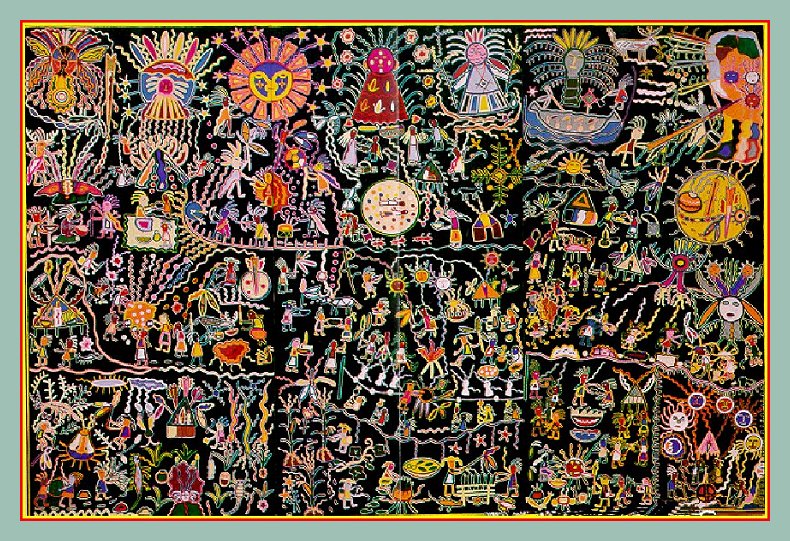
Arte popular is a treasure trove of Mexican folk art.  Each section of the book contains a different type of art from a particular region.  Large, detailed photographs, interviews with artists and craftspeople, and information about each art form's history and functions show readers how diverse and useful art can be.  For example, readers will learn that art can:

Be clothing (like huipiles in Oaxaca)

Depict religious beliefs and understandings 
(like Huichol tapestries in Nayarit, Jalisco, Durango, and Zacatecas)

Help people observe special occasions (like papel picado in Puebla)

Before introducing each art form, Nina Shor encourages readers to examine each work closely by providing them with a list of details to search for as well as questions to consider.  This challenge makes the book more interactive and asks children to think more deeply about what they're seeing.

Since the text is in Spanish and intended for more advanced readers, younger and/or monolingual English-speaking kids might need adult assistance when gleaning information from this book.  Children can certainly enjoy the artwork on their own, but their experiences with this book will be so much richer if they can access the text and learn about the meanings behind the photographs.  Therefore, I would recommend Arte popular to Spanish, dual language, Mexican American Studies, and Spanish-speaking art teachers.  Or, if you don't speak Spanish but know someone who wants to help you translate, go for it!  This book is too good to pass up.

Saturday, February 14, 2015

What's Skippyjon up to These Days?

As a teacher, I never liked the Skippyjon Jones series, although I could never explain why.  Well, I knew they were extremely difficult and annoying to read aloud because they're giant tongue twisters, but it was something more than that.  Now that I'm more familiar with the study of multicultural children's literature, I can name the vague sense of discomfort every time a student asked me to read one of these books.

To quote Skippyjon Jones and the Big Bones, they're "insane-o."

For those of you who aren't familiar with the series, it centers on a Siamese kitten who wants to be a Chihuahua and goes on wild adventures with his imaginary chihuahua friends.  Together, they speak a good deal of mock Spanish by adding -o and -ito (e.g., "Jurassic-o, " "marshmallocito") to the ends of words.  Lots of fake Mexican accents ("reelly, reelly beeg"), negative portrayals Mexicans ("crazy-loco," banditos, etc.), and very inauthentic uses of the Spanish language.


Carmen Martínez-Roldán, professor of bilingual/bicultural education at Teachers College, wrote a very interesting study about these books a couple of years ago, in which she examined stereotypes and mock Spanish that permeate them.  These depictions of ethnicity and language, she argued, can negatively impact young Spanish-speaking, Mexican-heritage children's self image, while also filling other children's heads with shallow, inaccurate, and unfair perceptions of how Mexican people speak and act.  However, she also pointed out that these books can be useful tools for helping children practice critical reading skills and uncover and discuss harmful depictions of culture and language.  Here's a link to the abstract (and if you'd like to read the full article, head to a university library website and download it, or, if you don't have access to one of those, the nice people at your local public library can probably help you find a copy).

Dr. Martínez-Roldán isn't the only person critiquing the series.  Just take a look at readers' reviews on Amazon and GoodReads or this review at De Colores, and you'll see that lots of people have had negative reactions.

So the other day, I saw the newest Skippyjon book, Snow What (2014), and was immediately seized by curiosity.  


Judy Schachner, the author/illustrator, has been receiving a fair amount of criticism for years now, so I wondered whether she had moved away from the stereotypes.  Here's what I found, starting with the description of the book on her website:
Mirror mirror on the wall, who is the bravest Chihuahua of them all? Skippyjon Jones, the Siamese cat who thinks he’s a dog! While his sisters listen to Snow White and the Seven Dwarves, Skippy bounces on his big-boy bed and heads off for the REAL adventure awaiting him in his closet. Once inside, he finds himself in a magical snowy forest of make-believe, where the seven Chimichangos challenge him with his most dangerous task yet: to wake up Nieve Que [sic], the frozen princess, by kissing her! Yuck! Will this hero agree to don a prince’s pantelones [sic] and save his poochitos?  With rhymes, rollicking wordplay, and mucho fairy tale fun, this fuzzy tale is sure to end happily ever after.
(Note: One of the gags in the book is that Skippyjon keeps saying "Snow What" instead of "Snow White."  "Nieve Qué" is a literal translation of "Snow What," and... yeah.)

OK.  So far we see "Chimichangos," "poochitos," and a random mucho.  Also, pantalones is spelled incorrectly.  Onto the book.

While there aren't any obvious stereotypes about Mexicans in this book, there's still plenty of "rollicking wordplay" that involves slapping -o and -ito onto the ends of words: "Skippito Friskito," "smoochito," "indeed-o."  In an interesting twist, there are also a lot of correctly used Spanish words that readers can figure out and learn from context and illustrations.  For example, one of Skippyjon's chihuahua friends grumbles, "Some dog has been chewing my zapato," while holding a shoe in his mouth.  But does this linguistic choice make up for the rest of it?  Not for me.

Finally, there's this video: an interview with Judy Schachner, in which she describes Snow What and discusses her inspiration for Skippyjon.  Based on what she says, I don't think she's changed her mind about mock Spanish and stereotypes.  (Also, despite his portrayal of Zorro and other Mexican characters, Antonio Banderas is from Spain, not Mexico.)

I've heard people defend the Skippyjon books because they're fun and promote creativity and imagination.  According to some reviews I've read, others like them because they introduce children to Spanish.  But there are so many other picture books that simultaneously celebrate imagination and humor and affirm language and culture.  Why not go for those books instead?  

I think a lot of parents and kids stick to Skippyjon because he's familiar, cute, seemingly innocuous, and extremely popular.  They might not know about the more culturally sustaining literature out there in kidlit land.  What we can do is (gently) point out the problematic elements in the series and then suggest fun, Spanish-containing, culturally sustaining books.  We can ask booksellers to prominently display more bilingual and "code-switching" books (texts that are in English but contain some Spanish words) so that shoppers notice them.  And we can share book reviews and other multicultural children's literature resources to help get conversations started.  Here are a few that I've found especially helpful:
Long story short: Skippyjon Jones is still up to his mock Spanish ways -- use those books for critical reading.  Buy other books to teach Spanish and learn about Mexican cultural practices.  We can do so much better.

Tuesday, February 10, 2015

Review: Ka'ya ta kutu'a kun Ñuu Savi

Title: Ka'ya ta kutu'a kun Ñuu Savi / Adivinanzas en mixteco, la lengua de la lluvia / Mixtec Riddles
Compiled by: Alejandra Cruz Ortiz
Illustrator: Octavio Moctezuma Vega
Publisher: Artes de México
Age Range: 4+

You might have noticed that bilingual books are (thankfully) somewhat easier to find these days, but have you ever seen a quintilingual book?  Well, guess what I found in Mexico.

Oh yes.

This colorful book of riddles offers readers brainteasers in five languages -- three varieties of Mixtec, Castilian Spanish, Catalan, and English.  For those of you who, like me, aren't super familiar with Mixtec, here's brief introduction from mixtec.org:
"Mixtec belongs to the Otomanguean group of Mesoamerican languages.  Proto-Otomanguean, the mother language, was spoken by hunters and gatherers in the region over 10,000 years ago.  A forerunner of contemporary Mixtec appeared some 7,000 years ago.
"It is misleading to talk about Mixtec language as a single, uniform system of oral and written communication.  By some estimates, there are thirty or even fifty variations of the language, some of which are very different from one another.  Residents of settlements separated by a few miles may only understand about 10-25% of what each other says [....]
"In the 500+ years since the arrival of Cortés, Mixtec has adopted or adapted Spanish words for which there are no Mixtec equivalents.  And today, because of the heavy migration between Oaxaca and the United States, Anglicisms are increasingly creeping into the language.  A startling, but no longer uncommon scenario in schools in the Mixteca [region were Mixtec is commonly spoken] is the following: A Spanish-only speaking teacher, educated in Mexico City, leads a classroom comprised of Mixtec-only speaking students, bilingual Mixtec-Spanish speakers, and bilingual Mixtec-English speakers."

Areas of Mexico where Mixtec languages are spoken

This passage illustrates how rich and complex languages are in Mexico.  With so many linguistic traditions coming together and mingling, it seems wise to create books like this one that recognize and utilize several of them together.  Also, I love how the book honors the Mixtec varieties -- which, sadly, some people view as useless or inferior -- by placing them first on the page instead of below Spanish or English, two more dominant, privileged languages.

Would you like a preview?  Here's a riddle:

Pinotepa, Oaxaca
Yu'u chavixi kuui vati chike nuu ndi'i ita
Chakan ñi ña'an kuniñi ko'oñi ñuñuyu
Ri saa ndio'o.

Xalpatláhuac, Guerrero
Visi ni vaku il chi
Xika ni'i nuu ita
Soo ndi'i na si'i ndiki na ko'o na ñuñu ii
Miñaa nada yo ku ii kuka'ndo.

Huajuapan, Oaxaca
Yu'u kuu iin ña v idji chii xikanuui tanuu,
tanuú ita ta ndi'i ña'a kutondodjo ñuñui kunina.

Castellano
¿Ya sabes quién soy?
Chiquito de mil colores,
por el lugar de las nubes voy.
Del dulce de mil flores
me deleito con sus sabores.

Català
Petit ocell multicolor
Vaig per les flors tastant sabors.
No pots endevinar qui sóc?

English
Even though I'm small in size,
I have many colors to delight the eyes.
I like to spend hours and hours
Drinking sweetness from the flowers.

And the answer is...

Yoo kuu yu'u: Saa ndio'o
Saa ndio va ku ii
Ndiyoo kuui. Ndiyo'o
El colibrí
El colibrí
Hummingbird

Love it.  And just think of all the possibilities for using this book in your classroom or at home with your children.  You might discuss translation and issues of linguistic diversity and marginalization with older kids, or you might provide younger students with opportunities to write their own riddles in any language they want.

As for me, I'll be giving Ka'ya ta kutu'a kun Ñuu Savi to my friends who are raising their son to speak Catalan, Spanish, and English, because seriously -- how many North American-published books can you think of that include Catalan (another marginalized, persecuted language)?  If you'd like to snatch up a copy for yourself, you can order it directly from the publisher or buy it used through Amazon or Barnes & Noble.  Enjoy!

Tuesday, February 3, 2015

2015 ALSC/ALA Award Winners

In case you haven't heard, the Association for Library Services to Children / American Library Association announced their children's and young adult literature award winners yesterday, and the list is really diverse!  I was especially excited to see two of my favorites -- Green Is A Chile Pepper and Separate Is Never Equal -- on the Pura Belpré and Sibert Honor lists.  Congratulations to all of the winners!


I've been wanting to share this guest post I wrote about Separate Is Never Equal for my friend and colleague Jenn Whitley's blog, Teaching Social Justice, last summer.  Now seems like a good time, so here you go!  While you're there, take a look around -- Jenn and her guest bloggers (all of whom are way smarter than me) have written some excellent posts about the intersections of education and social justice.  Prepare to have your brain flexed.

Monday, January 26, 2015

The Importance of Orature

Back in December, I read this article from Latino Rebels, in which Charlie Vázquez mourns the loss of family stories that have been passed down orally for years.  As his older relatives have passed on, he laments, their stories have died with them, inspiring him to preserve his "family folklore" by writing it down.  While I understand Vázquez' decision to record these oral tales and histories in print, this article makes me wonder: Why aren't we doing more to keep the practice of oral storytelling alive?

I love books.  You love books.  We understand that reading can be a beautiful, edifying experience and that the written word holds immense power.  However, by privileging print in our culture, we run the risk of marginalizing and losing the art of oral storytelling, another powerful form of sharing ideas.  Yes, writing down orature and oral history is probably prudent in parts of the world where print dominates, but I believe that we should continue telling those stories aloud as long as we can.

Promoting oral storytelling has several benefits.  First, it keeps cultures and knowledge alive.  Second, valuing this form of communication values the people who practice it.


Additionally, providing children with lots of chances to hear and tell diverse stories at school and at home can:


Don't know where to begin?  Teachers, you can invite parents or professional storytellers to visit schools, or give students opportunities to share tales (historical, folkloric, or imaginary) aloud.  Parents, check out your local library for storytelling events, or head to YouTube -- there are tons of great storytelling videos online (like this one).

(Personal testimony time: I have to confess that I didn't fully recognize the value of orature when I was teaching, but when I did tell stories to my kids sans picture book and took them to see storytellers at a local theater, they loooooooved it.)

Have you experienced oral storytelling or welcomed it into your classroom?  Tell me about it!

Monday, January 19, 2015

KidLit in Puebla

Hey everyone!  Well, I took a nice, long break from blogging, so I'm rested and ready to get back to all things children's literature.  I hope y'all enjoyed your holidays and are having a great start to the new year!

Earlier this month, I had the opportunity to travel to Puebla, Mexico, and... wow.  Seriously, if you're into traveling, put it on your list right now -- it's a beautiful, friendly place with way too much to do.  Here are some highlights:

Approximately one billion churches

Colonial buildings covered with Talavera tile

Mesoamerican ruins (and more churches) in nearby Cholula

A sweet old library

Slightly terrifying volcanoes

And bookstores!  Bookstores everywhere, from tiny spaces and stalls selling used novels to big, shiny stores filled with textbooks.  My favorite, however, was a non-profit organization called Profética: Casa de la Lectura (House of Literacy), which operates a store, library, and café.  (If you'd like more info, I Google-translated the Spanish Wikipedia article here.)

The store's children's section was perfect.


Over the past couple of years, I've done a lot of reading about Mexico's children's literature publishing industry, and I've learned that -- while there's been fantastic growth in the world of Mexican picture books -- translations of popular English-language titles and series (like Disney, Barbie, Dora the Explorer, Harry Potter) are still very popular.  Also, books in Mexico ain't cheap, so I wasn't quite sure how big the demand (and therefore the supply) would be.  So when I walked into Profética, I didn't know how many children's books they would have or what kinds of titles I would see.

Overall, there was a great balance.  Yes, I found Barbie lurking on the shelves...


...but I also found translations of more "serious" children's lit authors like Anthony Browne.


And best of all, there were TONS of books created by Mexican authors, illustrators, and publishers.  I was especially excited to see several titles from Ediciones El Naranjo, one of my favorite publishing houses based in Mexico City.


It's kind of a miracle that I walked out of Profética with only four books in tow.  I'd tell you what they are, but I'll be reviewing them in the coming weeks, so they'll have to remain a secret for now :)

If you're ever in Puebla, hit this place up!  Or if you'd like to shop at Profética but aren't planning to go to Puebla anytime soon, you're in luck -- they have an online store and ship outside of Mexico.  The website is completely in Spanish, though, so if you're not familiar with the language, you might have to rely on a dictionary, online translator, or Spanish-speaking friend.  But don't let that stop you.  If you're hunting for Spanish-language or bilingual books, please consider giving them your business and supporting a wonderful literacy non-profit.  Have fun!

Sunday, December 21, 2014

Review: Diane Gonzales Bertrand's Cecilia & Miguel

Illustrator: Thelma Muraida
Age Range: 4+


My parents are celebrating their 47th wedding anniversary today, and everyone knows that the traditional gift for a 47th anniversary is a children's book review from the couple's weird PhD student daughter, so here you go, Mom and Dad!

(According to this website, the "modern" gift for 47 years is books, so this is working out better than expected.)

This week, I'm reviewing a sweet book that reminds me of my parents, who met in first grade, grew up together, dated in high school, broke up when they went to different colleges, reunited a couple of years later, got married, and eventually wound up with me.

Cecilia and Miguel Are Best Friends / Cecilia y Miguel son mejores amigos, a dual language picture book by San Antonio natives Diane Gonzales Bertrand and Thelma Muraida, presents a similar story.  In third grade, Cecilia and Miguel begin a friendship that weathers various challenges and frustrations.  Readers watch as the duo grow up and remain close, even when Cecilia excels at fishing while Miguel tangles and breaks his line, Miguel wins a bike race and Cecilia has to quit due to flat tires, and they play for different teams in high school.  Eventually, the two go off to different colleges, but even distance can't keep them apart -- they marry and later have twins, who love to look at their parents' photographs and hear the story of the friendship that created a family.

Everything in this book just fits.  I love how Thelma Muraida frames her warm, gentle illustrations in jagged photograph borders so that each page becomes an entry in the scrapbook that Cecilia and Miguel share with their children.  I love how Miguel gives Cecilia bunny ears in their third grade class picture, only to get bunny ears himself in their formal wedding portrait.


That's what you get, Miguel ;)

I love how Diane Gonzales Bertrand includes several common Mexican-American cultural practices that remind me of growing up in Texas -- piñatas, cascarrones, quinceañeras.  And I love how the story emphasizes how friendship is important in relationships, whether romantic, familial, or platonic.  When I have kids, I'll definitely be reading this one to them at bedtime.

Furthermore, teachers of English and/or Spanish learners can use the dual language text to help their students build vocabulary and grammar skills.  The words on each page follow the same pattern: "Cecilia and Miguel are best friends, even when... / Cecilia y Miguel son mejores amigos, aun cuando..."  Reading these repetitive phrases throughout the book can allow children to internalize these words and grammatical structures, making it easier to understand them and even use them in conversation and writing.

So if you're looking for a last-minute holiday gift for a child or teacher, consider Cecilia & Miguel -- it's the perfect addition to a home or classroom library.  Enjoy!