Showing posts with label review. Show all posts

Sunday, May 3, 2015

Review: Angela Johnson's All Different Now

Title: All Different Now: Juneteenth, the First Day of Freedom
Author: Angela Johnson
Illustrator: E.B. Lewis
Publisher: Simon & Schuster
Age Range: 8+


Attempting to learn about history from a textbook can be a dull, even futile effort.  As social studies education scholar Bruce VanSledright points out in his book The Challenge of Rethinking History: On Practices, Theories, and Policy (2011), textbooks present students with a number of obstacles that can hinder their acquisition of historical knowledge.  First, textbooks often gloss over historical happenings, "condensing rich, complex events into [...] compressed accounts" (p. 39) -- rushed, shallow, paragraph-long blurbs that can't possibly help readers build deep, nuanced interpretations about the past.  Instead, kids need to read various accounts (primary and secondary sources) that present different perspectives about historical events.  When they do so, they learn that history isn't quite as simple as a textbook might present it, and they begin to be able to handle constructively the dissonance that varying points of view can create -- a skill they'll need in the real world, a place full of diversity and sundry ways of being and thinking (Barton & Levstik, 2004).

Another problem with textbooks is that they often present history as a "fait accompli" (VanSledright, 2011, p. 79), a done deal or an open-and-shut account of events that can leave readers bored and wondering whether the past has any relevance in our present lives.  "Why should we care about what happened back then?" they might ask.  "Let's just memorize this boring story and get it over with."  But history has so much more to offer, and utilizing resources like All Different Now -- Angela Johnson's moving poem about a young girl learning on June 19, 1865 that she's free -- invites teachers and students to move beyond the textbook and reclaim the fascinating work of doing history.

What I really love about this book is how it brings the past to life and presents the first Juneteenth as a dynamic, open-ended occasion.  E. B. Lewis' illustrations -- watercolor representations of photographs -- look incredibly realistic, showing readers what people might really have looked like as they experienced their freedom for the first time.  Whereas textbooks often rely on flat, black-and-white photographs to represent the nineteenth century, these images are colorful and alive.  Children can clearly see that slaves were real people who had families, "worked [...] under the hot Texas sun" (Johnson, 2014, n.p.), and felt real joy when they learned about emancipation.


Moreover, Johnson's words and Lewis' illustrations convey to readers that the first Juneteenth and the following years were a complex period in history by implying that, after emancipation, things were "all different now," not "all better now."  Yes, readers will see the people in the book experiencing relief and happiness as they "ate as free people / laughed as free people / and told stories as free people" (Johnson, 2014, n.p.), but they will also see the uncertainty that many people felt as they moved forward into their new lives.  In the last two pages of the book, we read the words "all different now" and see the narrator's family leaving their slave quarters.  Their faces display a variety of emotions -- hope, concern, ambiguity.  While emancipation released Black Americans from the bonds of slavery, it wasn't the end of trouble, and many (if not most) former slaves faced continuing racism and violence.  I like how All Different Now acknowledges this reality and leaves the ending open.  The story isn't over; it's not an open-and-shut chapter in history; it's not a "fait accompli."


Introducing this book in the classroom and constructing lessons around it can provide students with learning opportunities to foster not only their historical thinking skills but also other academic abilities.  Reading All Different Now and other primary and secondary sources about Juneteenth (in addition to or in place of textbook reading) can allow students to compare multiple perspectives about the event, encouraging them to develop a more nuanced understanding about emancipation.  Also, teachers can help students connect past and present by investigating how Juneteenth is celebrated today.  For example, if some students observe this holiday themselves, they can invite family members and friends to teach their classmates more about contemporary celebrations.  Furthermore, engaging with this book can strengthen children's literacy skills (Duke, Bennett-Armistead, & Roberts, 2003).  Encountering new words can build vocabulary (Dreher, 2003), while teachers can encourage students to develop their writing skills by creating their own poetry about a historical event (Ray, 2004).

Juneteenth celebration in Austin, 1900

With all of the great nonfiction and historical fiction children's literature out there, teachers don't have to worry about relying on textbooks.  By welcoming books like All Different Now into the classroom, we can give our students all kinds of wonderful opportunities to connect with the past.

Helpful Resources
  • An article by Henry Louis Gates, Jr., containing several quotations (primary sources) from former slaves about Juneteenth and emancipation
  • Some examples of how Galveston, Texas (where emancipation was announced) celebrates Juneteenth today  

References

Barton, K. C., & Levstik, L. S. (2004). Teaching history for the common good. Mahwah, NJ: Erlbaum.

Dreher, M. J. (2003). Motivating struggling readers by tapping the potential of information books. Reading & Writing Quarterly, 19, 25-38.

Duke, N., Bennett-Armistead, V. S., & Roberts, E. M. (2003). Filling the great void: Why we should bring nonfiction into the early-grade classroom. American Educator, 27(1), 30.

Johnson, A. (2014). All different now: Juneteenth, the first day of freedom. New York, NY: Simon & Schuster. 

Ray, K. W. (2004). Why Cauley writes well: A close look at what a difference good teaching can make. Language Arts, 82, 100-109.

VanSledright, B. (2011). The challenge of rethinking history education: On practices, theories, and policy. New York, NY: Routledge.

Sunday, April 12, 2015

Book Talks at Latin@s in Kid Lit :D

I don't think I've mentioned it here yet, but the lovely folks at Latin@s in Kid Lit -- a group blog run by some amazing authors, illustrators, librarians, students, and teachers -- have invited me to contribute some book reviews for their "Libros Latinos" feature.  I'm so excited to join the team!  Last month, I wrote a review of Jorge Argueta's Talking with Mother Earth / Hablando con Madre Tierra, and I have another review coming out at the end of April.

 
Here are some hints about the book I'll be discussing:
  • It's a new release.
  • It's a picture book.
  • It's tasty.
  • The illustrations connect past and present.
Can you guess?  Hope to see you over at Latin@s in Kid Lit!

Monday, February 23, 2015

Review: Nina Shor's Arte Popular

Title: Arte popular: Búscalo y encuéntralo (Folk Art: Look and Find)
Author: Nina Shor (Mexico)
Illustrator: Various artists (Mexico)
Publisher: Ediciones El Naranjo
Ages: 6+


The children's literature library in my university's education building has a great, growing collection of Spanish and dual language books, and I first noticed this title on the New Arrivals shelf a few months ago.  I love me some traditional arts and crafts and was curious to see what was inside, but I didn't have any time to stop and look at the book, so I left and forgot about it.

Until I saw the same book in that magical bookstore in Puebla and snatched it right up.

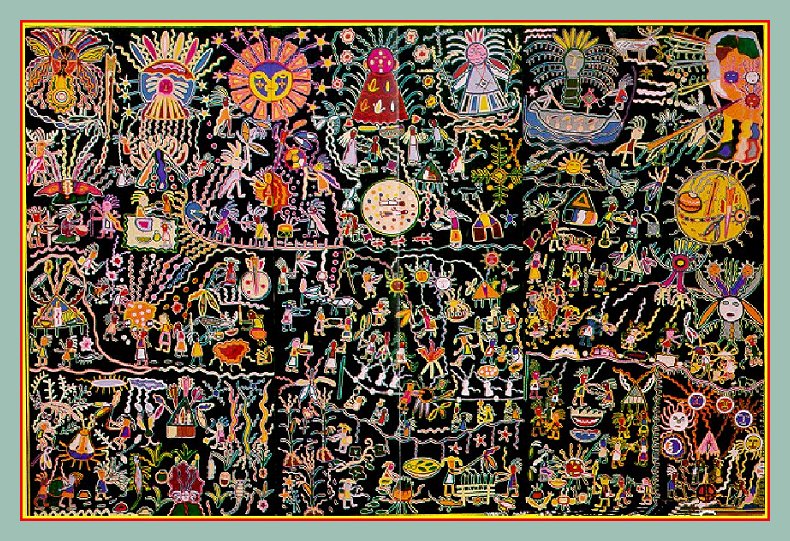
Arte popular is a treasure trove of Mexican folk art.  Each section of the book contains a different type of art from a particular region.  Large, detailed photographs, interviews with artists and craftspeople, and information about each art form's history and functions show readers how diverse and useful art can be.  For example, readers will learn that art can:

Be clothing (like huipiles in Oaxaca)

Depict religious beliefs and understandings 
(like Huichol tapestries in Nayarit, Jalisco, Durango, and Zacatecas)

Help people observe special occasions (like papel picado in Puebla)

Before introducing each art form, Nina Shor encourages readers to examine each work closely by providing them with a list of details to search for as well as questions to consider.  This challenge makes the book more interactive and asks children to think more deeply about what they're seeing.

Since the text is in Spanish and intended for more advanced readers, younger and/or monolingual English-speaking kids might need adult assistance when gleaning information from this book.  Children can certainly enjoy the artwork on their own, but their experiences with this book will be so much richer if they can access the text and learn about the meanings behind the photographs.  Therefore, I would recommend Arte popular to Spanish, dual language, Mexican American Studies, and Spanish-speaking art teachers.  Or, if you don't speak Spanish but know someone who wants to help you translate, go for it!  This book is too good to pass up.

Tuesday, February 10, 2015

Review: Ka'ya ta kutu'a kun Ñuu Savi

Title: Ka'ya ta kutu'a kun Ñuu Savi / Adivinanzas en mixteco, la lengua de la lluvia / Mixtec Riddles
Compiled by: Alejandra Cruz Ortiz
Illustrator: Octavio Moctezuma Vega
Publisher: Artes de México
Age Range: 4+

You might have noticed that bilingual books are (thankfully) somewhat easier to find these days, but have you ever seen a quintilingual book?  Well, guess what I found in Mexico.

Oh yes.

This colorful book of riddles offers readers brainteasers in five languages -- three varieties of Mixtec, Castilian Spanish, Catalan, and English.  For those of you who, like me, aren't super familiar with Mixtec, here's brief introduction from mixtec.org:
"Mixtec belongs to the Otomanguean group of Mesoamerican languages.  Proto-Otomanguean, the mother language, was spoken by hunters and gatherers in the region over 10,000 years ago.  A forerunner of contemporary Mixtec appeared some 7,000 years ago.
"It is misleading to talk about Mixtec language as a single, uniform system of oral and written communication.  By some estimates, there are thirty or even fifty variations of the language, some of which are very different from one another.  Residents of settlements separated by a few miles may only understand about 10-25% of what each other says [....]
"In the 500+ years since the arrival of Cortés, Mixtec has adopted or adapted Spanish words for which there are no Mixtec equivalents.  And today, because of the heavy migration between Oaxaca and the United States, Anglicisms are increasingly creeping into the language.  A startling, but no longer uncommon scenario in schools in the Mixteca [region were Mixtec is commonly spoken] is the following: A Spanish-only speaking teacher, educated in Mexico City, leads a classroom comprised of Mixtec-only speaking students, bilingual Mixtec-Spanish speakers, and bilingual Mixtec-English speakers."

Areas of Mexico where Mixtec languages are spoken

This passage illustrates how rich and complex languages are in Mexico.  With so many linguistic traditions coming together and mingling, it seems wise to create books like this one that recognize and utilize several of them together.  Also, I love how the book honors the Mixtec varieties -- which, sadly, some people view as useless or inferior -- by placing them first on the page instead of below Spanish or English, two more dominant, privileged languages.

Would you like a preview?  Here's a riddle:

Pinotepa, Oaxaca
Yu'u chavixi kuui vati chike nuu ndi'i ita
Chakan ñi ña'an kuniñi ko'oñi ñuñuyu
Ri saa ndio'o.

Xalpatláhuac, Guerrero
Visi ni vaku il chi
Xika ni'i nuu ita
Soo ndi'i na si'i ndiki na ko'o na ñuñu ii
Miñaa nada yo ku ii kuka'ndo.

Huajuapan, Oaxaca
Yu'u kuu iin ña v idji chii xikanuui tanuu,
tanuú ita ta ndi'i ña'a kutondodjo ñuñui kunina.

Castellano
¿Ya sabes quién soy?
Chiquito de mil colores,
por el lugar de las nubes voy.
Del dulce de mil flores
me deleito con sus sabores.

Català
Petit ocell multicolor
Vaig per les flors tastant sabors.
No pots endevinar qui sóc?

English
Even though I'm small in size,
I have many colors to delight the eyes.
I like to spend hours and hours
Drinking sweetness from the flowers.

And the answer is...

Yoo kuu yu'u: Saa ndio'o
Saa ndio va ku ii
Ndiyoo kuui. Ndiyo'o
El colibrí
El colibrí
Hummingbird

Love it.  And just think of all the possibilities for using this book in your classroom or at home with your children.  You might discuss translation and issues of linguistic diversity and marginalization with older kids, or you might provide younger students with opportunities to write their own riddles in any language they want.

As for me, I'll be giving Ka'ya ta kutu'a kun Ñuu Savi to my friends who are raising their son to speak Catalan, Spanish, and English, because seriously -- how many North American-published books can you think of that include Catalan (another marginalized, persecuted language)?  If you'd like to snatch up a copy for yourself, you can order it directly from the publisher or buy it used through Amazon or Barnes & Noble.  Enjoy!

Sunday, December 21, 2014

Review: Diane Gonzales Bertrand's Cecilia & Miguel

Illustrator: Thelma Muraida
Age Range: 4+


My parents are celebrating their 47th wedding anniversary today, and everyone knows that the traditional gift for a 47th anniversary is a children's book review from the couple's weird PhD student daughter, so here you go, Mom and Dad!

(According to this website, the "modern" gift for 47 years is books, so this is working out better than expected.)

This week, I'm reviewing a sweet book that reminds me of my parents, who met in first grade, grew up together, dated in high school, broke up when they went to different colleges, reunited a couple of years later, got married, and eventually wound up with me.

Cecilia and Miguel Are Best Friends / Cecilia y Miguel son mejores amigos, a dual language picture book by San Antonio natives Diane Gonzales Bertrand and Thelma Muraida, presents a similar story.  In third grade, Cecilia and Miguel begin a friendship that weathers various challenges and frustrations.  Readers watch as the duo grow up and remain close, even when Cecilia excels at fishing while Miguel tangles and breaks his line, Miguel wins a bike race and Cecilia has to quit due to flat tires, and they play for different teams in high school.  Eventually, the two go off to different colleges, but even distance can't keep them apart -- they marry and later have twins, who love to look at their parents' photographs and hear the story of the friendship that created a family.

Everything in this book just fits.  I love how Thelma Muraida frames her warm, gentle illustrations in jagged photograph borders so that each page becomes an entry in the scrapbook that Cecilia and Miguel share with their children.  I love how Miguel gives Cecilia bunny ears in their third grade class picture, only to get bunny ears himself in their formal wedding portrait.


That's what you get, Miguel ;)

I love how Diane Gonzales Bertrand includes several common Mexican-American cultural practices that remind me of growing up in Texas -- piñatas, cascarrones, quinceañeras.  And I love how the story emphasizes how friendship is important in relationships, whether romantic, familial, or platonic.  When I have kids, I'll definitely be reading this one to them at bedtime.

Furthermore, teachers of English and/or Spanish learners can use the dual language text to help their students build vocabulary and grammar skills.  The words on each page follow the same pattern: "Cecilia and Miguel are best friends, even when... / Cecilia y Miguel son mejores amigos, aun cuando..."  Reading these repetitive phrases throughout the book can allow children to internalize these words and grammatical structures, making it easier to understand them and even use them in conversation and writing.

So if you're looking for a last-minute holiday gift for a child or teacher, consider Cecilia & Miguel -- it's the perfect addition to a home or classroom library.  Enjoy!

Tuesday, December 9, 2014

Review: Manlio Argueta's Magic Dogs of the Volcanoes

Title: Magic Dogs of the Volcanoes / Los perros mágicos de los volcanes
Author: Manlio Argueta (El Salvador)
Illustrator: Elly Simmons (US)
Publisher: Children's Book Press
Ages: 4+


Imagine a picture book that can be a powerful, entertaining, and appealing educational tool for preschoolers and high schoolers alike.  Drawing from the folklore of his native El Salvador, renowned author and political activist Manlio Argueta delivers with Magic Dogs of the Volcanoes / Los perros mágicos de los volcanes.  In this book, Argueta introduces readers to cadejos, mythical Central American creatures with the looks of a wolf and the grace of a deer.  According to legend, cadejos live around volcanoes (who are their great-great-grandparents), eat the seeds of morning glory flowers, and protect the local people from harm.

Everyone loves the cadejos and their kindness, except for Don Tonio, a rich landowner, and his thirteen brothers, who employ – or overwork, rather – the townspeople.  These men believe that the cadejos’ care makes the people weak and lazy, so they call upon some “lead soldiers” to get rid of the kindly creatures.  Fortunately, the cadejos have the power of invisibility, which helps them evade the soldiers at first.  However, when the men begin killing the morning glories, the creatures’ only food source, the cadejos’ volcanic ancestors must come to the rescue.

This book has something to teach students of all ages.  Younger children will enjoy the magical story, experiencing the folklore of El Salvador, and learning how another culture values and respects the natural world.  They’ll also love Elly Simmons’ detailed, earth-toned pastel illustrations, which clearly convey the candejos’ friendly mischief and bring the massive volcanoes to life.

Meanwhile, Argueta’s tale is also perfect for older students interested in Latin American history and politics.  Written during the final years of the Salvadoran Civil War – during which oligarchs and the military oppressed and terrorized rural civilians – Magic Dogs of the Volcanoes / Los perros mágicos de los volcanes mirrors this turmoil with its portrayal of conflict between the elitist Don Tonio, his lead soldiers, and the townspeople who must rely on their (super)natural surroundings for help.

Moreover, the book’s side-by-side bilingual format makes it a helpful text for Spanish and English learners of any age.  Argueta’s inclusion of words unique to Central America, such as cadejo, cipote (child), and the local names for two volcanoes (Tecapa and Chaparrastique) gives the language a distinctly Salvadoran flavor. 


I’m so grateful that I stumbled across this multifaceted tale in my local public library, and I recommend that you run out and borrow or buy a copy – you won’t regret it.  Also, for more information on the author and teaching this book, check out the following links:  

Tuesday, November 18, 2014

Review: Monica Brown's Clara and the Curandera

Title: Clara and the Curandera / Clara y la curandera
Author: Monica Brown (Arizona, US)
Illustrator: Thelma Muraida (Texas, US)
Publisher: Arte Público / Piñata Books
Ages: 4+


Whenever I felt grumpy or down as a child, my parents suggested that I try helping others in order to get my mind off of myself, and I found that this strategy often did the trick.  Later, as an early childhood teacher, I advised my students to do the same whenever they were having a difficult time escaping a grumpy mood.  In Clara and the Curandera / Clara y la curandera, Monica Brown addresses this topic in a warm, gentle manner that can both counsel and entertain young readers. 

As the story opens, Clara is irritated – at having to take out the trash, at her reading homework, at sharing with her siblings.  Her mother, fed up with Clara’s foul mood, exasperatedly demands that she go see the wise curandera (traditional healer, or, in this case, a wise older woman) down the hall.  When the kind curandera asks her about her problems, Clara confesses that she’s “tired of not having any space to [herself]” (n.p.).  The older woman quickly replies that, in addition to performing all of her regular tasks, she must also take out her elderly neighbors’ trash, share all of her toys with her siblings, and read not one but five books during the next week.  

Reluctantly, Clara agrees, and she soon finds that following the curandera’s instructions has improved her mood.  She suddenly takes great pleasure in helping her neighbors, spending time with her family, and, most of all, reading at the library.  In the end, Clara decides to continue heeding the curandera’s advice.


In addition to teaching children about the joys of giving and learning, this dual language book can help both Spanish and English learners develop their language skills -- especially vocabulary related to emotions (enojada/annoyed, sorprendida/surprised, feliz/happy).  Meanwhile, Thelma Muraida's soft, warm pencil illustrations reinforce the plot, while small retablo-style drawings placed in between the English and Spanish text delight the eye as young readers work their way through the story.


Furthermore, teachers can use this book (and others) to help their students learn more about curanderismo, or the traditional healing arts popular in Latin America and parts of the US with deep Latin@ heritage.  While the curandera in this book simply dispenses wisdom, other curander@s are practitioners of herbal medicines, midwifery, and spiritual healing.  Therefore, this book might be a good addition to learning units about occupations, community helpers, and the diversity of Latin American / Latin@ cultures.  For more resources, please see the links below:

Review: Amalia Astorga's Efraín of the Sonoran Desert

Title: Efraín of the Sonoran Desert
Authors: Amalia Astorga (Mexico), as told to Gary Paul Nabhan (US)
Illustrator: Janet K. Miller (US)
Publisher: Cinco Puntos Press
Age range: 6+


It's Native American Heritage Month, and while we we're hopefully considering Native American issues (both historical and contemporary) year-round, it's a good time to collectively focus on the diversity and contributions of indigenous Americans to within their communities and larger society.  (And by "Americans," I mean North and South Americans.)

Therefore, I'll be taking a look at a book I've been wanting to review for a long time -- Efraín of the Sonoran Desert.  This book tells of the Seri people (or Comcaac, as they call themselves) of northern Mexico and their relationship with endangered local lizards.  


In an introduction, famed ecologist Gary Paul Nabhan shares a story about a visit to a Comcaac town, where he notices that several species of endangered lizards are thriving around the people.  His curiosity leads him to ask a local woman, Amalia Astorga, what she knows about the animals.

At this point, Astorga assumes the role of narrator and tells the tale of her friendship with Efraín, a lizard she nurtured for seven years.  It becomes clear that the Comcaacs' care for local animals is helping them thrive while habitat destruction in other parts of the desert is endangering all kinds of wildlife.

Overall, I have mixed feelings about this book, but I'll start my review with what I like.  First, I like that Astorga shares her own story -- she's even listed as the author of the book.  Since the dominant culture so often silences the voices of indigenous people, it's wonderful to see that Astorga's voice is included here.  Her story matters.

Second, I like how this book privileges the Comcaac people's views on conservation.  In the Americas, our way of "doing science" is heavily influenced by European-style research and practice.  We tend to trust knowledge backed up by intricate instruments, the scientific method, and peer-reviewed studies -- not that there's anything wrong with that.  Meanwhile, however, we often dismiss indigenous knowledge, or the various ways that indigenous peoples, like the Comcaac, study and understand the natural world.


In other words, we've been socialized to trust the word of a college-trained ecologist like Gary Paul Nabhan -- an outsider who has spent relatively little time in the Sonoran desert over the word of a woman like Amalia Astorga -- who has spent her life interacting with the animals in her local environment.  Therefore, it's a relief to read Astorga's own words, to hear her ideas and understandings.

Lastly, I like how Nabhan describes how the Comcaac people are in charge of their lives and their contemporary situation without casting them as victims or noble savages.  Their population is small, and there are pressures to assimilate into "mainstream" Mexican society, but these people aren't doomed.  Instead, adults "are actively teaching their language and traditions to their children so that language loss will never occur in their homeland" (p. 28).  They're real people facing challenges and preserving their cultural practices in the real world.

But.

I find several aspects of this book problematic.  For instance, Astorga's story is sandwiched between several pages of introduction and epilogue from Nabhan.  Why does he have to frame her story?  Do we need a "real scientist" (i.e., someone holding degrees from US universities) to vouch for her?  Why can't we just focus on Astorga's viewpoints?  I'd really rather read her descriptions of her community in addition to her story about Efraín.

Also, I'm uncomfortable with the language Nabhan uses to describe the Comcaac.  First, he calls them "Seri" -- a name given to them by outsiders -- even though the local people prefer to call themselves "Comcaac."  Why not use their actual community name?  Then there's the phrase "endangered people" (pp. 4, 26).  Yes, I understand that he's quoting anthropologists, and yes, many indigenous people's traditional ways of living are under threat, but I just don't like that phrase.  In English, we so often use the word "endangered" to describe species of animals, so I'm not comfortable using that word to label humans.

Finally, I wish the publishers had invited a Comcaac artist to illustrate the book.  Janet K. Miller's illustrations are lovely, but I'd rather see art from the community.

Well, my response to this book is messy, but there it is.  What do you think?  Agree?  Disagree?  Let me know!

Monday, November 3, 2014

Review: Alma Flor Ada & Isabel Campoy's Yes! We Are Latinos

Title: Yes! We Are Latinos
Authors: Alma Flor Ada (Cuba, US) & Isabel Campoy (Spain, US)
Illustrator: David Diaz (US)
Publisher: Charlesbridge
Age range: 9+


I've been wanting to review this book ever since it came out last year, and I'm so excited to finally share it with you!  Yes! We Are Latinos is a stunning collection of poetry created by two prolific writers and scholars, Alma Flor Ada and Isabel Campoy.  Whether working separately or as a team, Ada and Campoy always produce thoughtful, charming works of children's literature -- and with this book, they've outdone themselves.

The purpose of Yes! We Are Latinos is to share and explain the diversity of Latin@ people living in the United States.  Rather than being a homogenous group, Latin@s have different ethnic backgrounds, live in different parts of the country, and speak different languages.  Therefore, each clear, uncluttered poem represents a fictional individual who shares information about his/her background and life with readers.

For example, Susana -- who has Sephardic Jewish heritage -- loves listening to her grandmother sing old, traditional songs and is trilingual -- fluent in English, Spanish, and Ladino (also known as Judeo-Spanish).

Felipe -- who identifies as Panamanian, Venezuelan, and Black -- wants to protect his cousin Angelita, who has Down Syndrome, from verbally abusive bullies.  But he wants to be her "champion" through painting, not fighting (p. 60).

Best friends Lili and Michiko -- who are Guatemalan-Chinese-American and Peruvian-Japanese-American, respectively --  are excited to learn more about their immigrant grandparents' home countries and languages.  However, they're also tired of telling people that they can, in fact, be simultaneously Asian-American and Latina.

Supplementing these poems are informative prose explanations of various historical events (slavery, the expulsion of Spain's Jewish population in the Middle Ages, the Spanish Civil War) and ongoing practices (immigration, the struggle for indigenous rights in the Americas) that clearly explain how the past and present have shaped the various ways to be Latin@.  Meanwhile, David Diaz' intricate black-and-white cut-out illustrations emphasize the poems without distracting readers from the text.

By exploring their characters' roots, struggles, and hopes, Ada and Campoy show readers the nuances of being Latin@ and successfully stress how Latin@ people lead very different lives and construct their identities in their own ways.


Because of Yes! We Are Latinos' true and loving celebration of diversity, teachers can easily incorporate it into an anti-bias curriculum.  After reading the poems together, teachers can also encourage students to write their own identity poems in which they describe their cultural backgrounds, family histories, personal interests, and the intersections of these complex facets of their lives.  

The poems are also wonderful resources for language learning.  Since Ada and Campoy weave Spanish seamlessly into their English-language verse, students of all language backgrounds can learn about the complexity of code-switching.  Moreover, the new Spanish translation of this book can be a great text for bilingual and Spanish as a Heritage/Foreign Language classrooms.

So go check out Yes! We Are Latinos!  But you don't have to take my word for it.